New 5-24-03, updated
10-27-08, 5-8-09, 3-20-10, 1-30-12, 6-13-12,
1-18-13, 10-11-14, 7-9-15, 9-5-17:
Getting Government Records
( Subpoenas, Discovery,
Public Records Act Requests, Hearsay, Traffic Accident
Stats, Emails )
The answer to the questions we never ask is always "no."
(Good advice to a red light camera ticket defendant, from his wife.)
When you ask for records, a few cities provide
the info without too much of a fuss. But
many cities throw up all kinds of barriers,
wasting a lot of their time, and taxpayers' money,
in an infantile game of "Keep Away."
Asking Nicely
At least one police department will email you a
copy of the photos and the video, just because you
phoned them and asked! Maybe that idea will
catch on with other departments. When you
phone "your" PD (the # is usually on the back of the
ticket) you'll probably get an answering
machine; you could leave your request, and
your email address, on the machine.
Each of the three
camera companies has a website that has the photos
and video on it. You go to the website,
identify yourself by typing in the ticket # and the
license plate # or PIN, and you get to see the
video. Keep in mind, though, that the photos
and video on the website will probably be of a lower
resolution than the "originals," or it may not be
the full length of the video.
Some other cities
go out of their way to try to keep you from getting
the photos. Most employ delaying tactics, to
grind you down, wear you out. Some go further,
and might tell you (verbally only, never in writing)
things like, "Legally, we cannot give you a copy."
If someone said that to me, I would be tempted to
ask them either (a), "Would you write me a note
saying that?" or (b), "Could you show me the law
that says that?" or (c), Would you please repeat
that after I start my tape recorder?"
Some cities issue tickets that don't display the Late Time, even though their systems clearly have the capability to do so. Other cities, those that are served by ACS, issue tickets with illegible Late Times. A possible motive for these cities to hide the Late Times could be so that they can cite for very short Late Times (like 0.1 second) without widespread criticism (including some from judges) about "Mickey Mouse" tickets. If you phone the PD to ask what your Late Time was, they may say that to get that information, you must come in to the police station. Your visit to the police station is an opportunity for them to grind you down, make it harder for you to fight your ticket. See Defect # 5 and the big How to Read Your Late Time box in Defect # 7 for more information.
Discovery
"I pursued system knowledge from the
police and the camera company: Difficult to
obtain. Even Torquemada and the Inquisition
encouraged its victims to become familiar with the
instruments of 'truth' before they were tested."
(An early defendant.)
Discovery is the process by which you are allowed to get, in advance, a copy of everything the city plans to use against you at your trial - including the photos and video! (Sometimes the city's website where they direct you to go to look at the photos from your ticket does not contain all the photos they have, or the full length of the video! And, the website photos will be of lower resolution than the originals.) If you are thinking about fighting your ticket, you should definitely file a Discovery request - without delay. Filing a Discovery request puts an end to many - but not all - of the city's delaying tactics.
(You may be able to obtain more than
the twelve seconds of video the city will show in
court. Some cities have access to 24/7 video from
their red light cameras, for 90 days or so. To
get, for example, the one minute of video surrounding
your alleged violation, you could do a public records
request - see section below. Or, you may need to
use a subpoena to get it.)
Fight
Your Ticket tells how to write and serve a
Discovery (for the page numbers, see my FYT Addenda page
and in the 14th Edition of FYT also see "Discovery" in
FYT's index), but please note -
(1) Timing: I strongly recommend that you FILE WITHOUT DELAY.
Ideally, you should file for Discovery at least 20 days
before your arraignment.
The latest date to file is generally 30 days before the
trial date.
|
Is It Ever Too Early
to Ask for Discovery?
Some authorities have been telling traffic ticket defendants that they cannot request discovery until they have been arraigned and have entered their plea. Baloney! Since the statutes (laws) regulating the Discovery process (Penal Code Section 1054) do not tell us how early we may request discovery, we must look to other sources: 1. The authoritative California Criminal Defense Practice, by Matthew Bender (available at every law library), says: "Neither Penal Code
Section 1054.5(b) nor Section 1054.7, nor any
other provision within Sections 1054 through
1054.7 specifies when informal discovery may first
be requested, nor do any of these provisions
prohibit the parties from requesting informal
discovery at the time of arrest, or at the time of
the filing of a criminal complaint, or at the time
an indictment is filed, well before any
arraignment or entry of plea has taken
place." (Bender,
Section 70.09[1][b] )
2. One Superior Court has published Discovery rules saying: "An informal discovery request can be made anytime after a case is filed." (See San Mateo local rules, in box below.) |
(2) The format: Your Discovery
request does not need to be on the
official-looking form shown in Fight Your Ticket,
or any other official form - these requests are most
often done informally, via an ordinary business letter
(see sample below, in the bluish 'wallpaper' area of
this page).
(3) Who to
serve: Although
it is technically incorrect, many cities tell defendants
(verbally, or in writing) to serve their Discovery on
the police.
Here's an example from one such city:
|
(These
rules
are
provided
by
highwayrobbery.net
solely
as
an
example
of
local
court
rules.
Some
of
these
rules
may
not
be
correct,
or
proper.)
Rule 9.9 Traffic Pre-Trial Discovery Motions. An informal discovery request can be made anytime after a case is filed. 1. The
defendant or his/her attorney must make this
request in writing and the original is to be filed
with the police agency that issued the
citation. [[[Editor's note: May not be
correct, or proper.]]] 2. The citing police agency has 15 days to respond and provide the requested material and information. 3. A copy of the informal request shall be filed with the District Attorney’s Office [[[Editor's note: May not be correct, or proper]]] who in turn will provide the Court Clerk’s office Traffic Division with a copy of the request. 4. If the police agency does not respond to the request within 15 days of service, the defendant may seek a court order to compel Discovery. 5. The motion to compel discovery must be filed at the earliest possible date and at least five court days prior to the trial date. Written notice must be served on all parties at least five court days prior to the hearing. The original written motion to compel discovery and the proposed order should be filed in the Court Clerk’s office Traffic Division with a copy served on the police agency that issued the citation and the District Attorney’s Office. The motion should indicate a hearing date that is before the trial date. From Santa Mateo
County Local Court Rules, amended July 1, 2007,
online at:
http://www.sanmateocourt.org/localrules/July_2007.pdf (These rules are provided by highwayrobbery.net solely as an example of local court rules. Some of these rules may not be correct, or proper. To look for local rules in another county, look on the website for that county's courts.) |
Again, a
requirement to serve the police is incorrect.
The law regulating the Discovery process (Penal Code
Section 1054),
which applies in every California county, imposes the
duty to provide Discovery to you upon the "prosecuting
attorney." That law does not impose that duty
upon the police, as their role in the matter is actually
as a witness. My advice is: A
copy of your request must
go to the city prosecutor or city attorney at City Hall,
or to whatever attorney is prosecuting you; it's
usually not
the district attorney. If you are at all
unsure as to which attorney to serve - the city
attorney, or the city prosecutor, or the district
attorney - don't waste any time or phone calls trying to
figure it out. It is faster and easier to just
serve all of them! It should be noted that some
cities, including some large ones, don't have a city
prosecutor.

DA, or city prosecutor? Some cities work
at deceiving you as to who to serve.
While the law does not require you to
file a copy of your informal Discovery request with
anyone other than the prosecuting attorney, some judges
don't seem to understand that - so also send a copy to
the court. And, if your court is actually
publishing written rules saying that you must serve the
police (see San Mateo example, above), serve the police,
too.
So, for those who don't want to spend a
lot of time researching exactly who to mail to, here is
the mailing list:
City Attorney, City Hall, (street address of city hall),
City, State, Zip.
City Prosecutor, City Hall, (street address of
city hall), City, State, Zip.
Traffic Unit, Police Department (or Sheriff Dept.),
(street address of station), City, State, Zip.
Superior Court Traffic Division, (street address of
court as shown on your ticket), City, State, Zip.
Discovery Unit, District Attorney, (street address of
his main office in the county seat), City, State, Zip.
Again, I strongly recommend that you FILE WITHOUT DELAY.
(4) How to serve
it: You don't need to send someone down to city
hall to make personal service of your informal Discovery
request. While the minimum requirement is to mail
it First Class and have an adult friend sign a Proof of
Service, I recommend that you send the prosecuting
attorney his copy twice, once by fax (program your
machine to print out a 'confirmer'), and once by
Certified Mail, Return Receipt requested, with a Proof
of Service signed by a friend. If you use mail to
send the judge his (optional) copy, get a Return
Receipt. Put your various proofs of service in
your case file (do not mail them to the court, or file
them there, as they could get lost), and bring them with
you to every court appearance, because the prosecuting
attorney (if he shows up at all) will almost always
claim that he/she didn't receive your Discovery request.
(5) If the prosecuting attorney
doesn't reply within 15 days (20 days if you served the
Discovery by mail), you will need to take further
action. See the "Dealing with..." section, below.
(6) Discovery goes both ways. If
you ask for Discovery, you also have to give it.
You have to tell the prosecuting attorney who your
witnesses will be, and you have to disclose the evidence
you plan to use at the trial.
In summary:
Get it done right away (don't
spend any time looking for a special form).
Serve everyone in sight. Get good proof of
service. And mark your calendar to follow up in
three weeks.
The Sample
Discovery Letter
The sample Discovery letter is below, in the bluish "wallpaper" area. You can add to it, or edit it down, but the last numbered item (Item 17), where you provide Discovery to the prosecution, is not optional. So don't edit it out!
If you just want to get a copy of the
photos or the video, and quickly, you could edit the
sample letter down to just a request for those photos,
Item 5 in the sample letter. (You will
still need to answer Item 17.) The limited
request might get you a quicker reply than asking for
all fifteen items! If you already have an
appointment to go view the pictures, you could try
handing the officer your discovery toward the end of
that visit. Maybe he or she will make a copy for
you on the spot - take a blank CD with you.
Dealing
with
the City's Response to Your Discovery
The
way
some cities reply to Discoveries is a clear attempt
to grind you down, run you around, and in general
keep you so busy trying to get the information that
you won't have the time or energy to really analyze
it (assuming you are able to get it at all).
Most
often
the
reply
will
come
from
someone
at
the
police
department.
And
his
or
her
reply
may
tell
you
that
you
need to contact other city personnel to obtain some
of the information you asked for. Well, one
department of the city is not supposed to slip out
of supplying the information by passing you along to
another department. You sent your Discovery to
the city attorney, and he is supposed to get all of
his city departments to supply the
information. You don't have to make separate
inquiries with each department. A ridiculous
example of this delaying tactic is where the police
tell you to contact the city attorney - the person
to whom you sent your request in the first place -
for a copy of whatever you were asking for.
And the most
ridiculous example of a delaying tactic was a city
attorney who told a defendant that the city didn't
handle Discovery requests, and that the defendant
would have to obtain the information from the courthouse.
Some
cities
try
very
hard
to
avoid
supplying
you
with
a
copy
of
the
violation
photos
and/or
video.
In
their
reply
to
your
Discovery request they use wording designed to give
you the impression that the only way you can see the
photos is to view them at the police
department. That is total baloney! Under
Discovery, they must
give you a copy.
I have also heard that in one county, some court
personnel - including one judge - have been telling
defendants that Discovery is not available for
traffic tickets (which are the lowest level of
criminal offense, infractions). More
baloney! Penal Code Section 19.7 says: "Except as
otherwise provided by law, all provisions of law
relating to misdemeanors shall apply to infractions..."
If the photos/video are
digital (most are, nowadays), ask them to email them
to you (the file size will be around 2 MB) or
put it on a CD. You
are entitled to get a copy of the same clarity, or
"generation," that they plan to use in
court. If
they
discover
a
low
resolution
copy
of
the
photos
to
you
and
then
at
court
they
try
to
use
a
high
resolution copy, I suggest that you object to their
use of it. Likewise, if they send you anything
less than the full 12 seconds of the video.
If
you
have received an unsatisfactory answer (or none) to
your Discovery request, telephone AND fax the city
attorney a request to talk about the
Discovery. Give him 24 hours to respond.
If he blows you off, or continues to delay, file a
motion. There is an example in Fight Your
Ticket.
I may have an example of such a motion available -
so that you will not have to type the whole thing
out.
Here is a defendant's description of his court battle about discovery.
Also
see
the
Nov.
2011
Blumenthal
decision,
on
my Library
page.
Another
resource is the Discovery materials at
helpigotaticket.com.
"Best
Evidence"
Here's my
untested (by me) theory of what to do if you've had a low
res. copy of the video (or other photos) discovered to
you. (Or if the officer is testifying about
the contents of a key document, but hasn't produced an
actual copy of that document.) There's a rule called
"Best Evidence." It means that at court they have to
submit their sharpest photo, not some fuzzy
copy. Or, if they are submitting a document,
they have to provide the uncondensed version of it, not a
summary of it or a memo about it. There's also the
rule that if they don't discover something to you in
advance, they can't use it at trial. My idea would
be to object to their use of the sharper video, since it
is different from what was discovered to you, and probably
contains a lot more information than the fuzzy one.
If the judge throws out the high resolution copy, the
police have no evidence against you, unless they are quick
on their feet and submit a lower res. copy as their
evidence - or even refer to your low res. copy, the one
they have
discovered. But if they tried to do that, I would
object to the admission of the low res. copy, under Best
Evidence.
(For more info about Best Evidence, Google "best evidence" California
rule. But beware of any Internet material
that cites Evidence Code Sections 1500 - 1519 - such
material would be outdated as 1500 - 1519 were replaced by
Section 1520 and up, several years ago, and it was
re-named "The Secondary Evidence Rule.")
Subpoenas
If
you
need
a
document
for
court
and
it's
not
among
the
types
of
documents
that
you
can
obtain
via
Discovery,
a
Subpoena Duces Tecum is the way to get
it. For court purposes, you can not rely
on a Public Records Act request - there is no
quick way to enforce the deadlines.
A
significant advantage of a Subpoena Duces
Tecum is that it can be done close to
the trial date. A disadvantage is
that the attorney for the City whose documents
you're asking for may file a motion to "quash"
your subpoena, claiming that the documents
you've asked for are not relevant to the
question of whether you ran the light.
Thus, you need to tailor your subpoena
carefully, to only ask for documents that you
believe you can prove are relevant.
(This contrasts with a Public Records Act
request, which carries no "relevance"
test.) An additional disadvantage
of using a subpoena is that you are not likely
to get to see the documents until the day of
your trial.
Although
it
is
not
required,
I
recommend
that
you
staple
your
subpoena
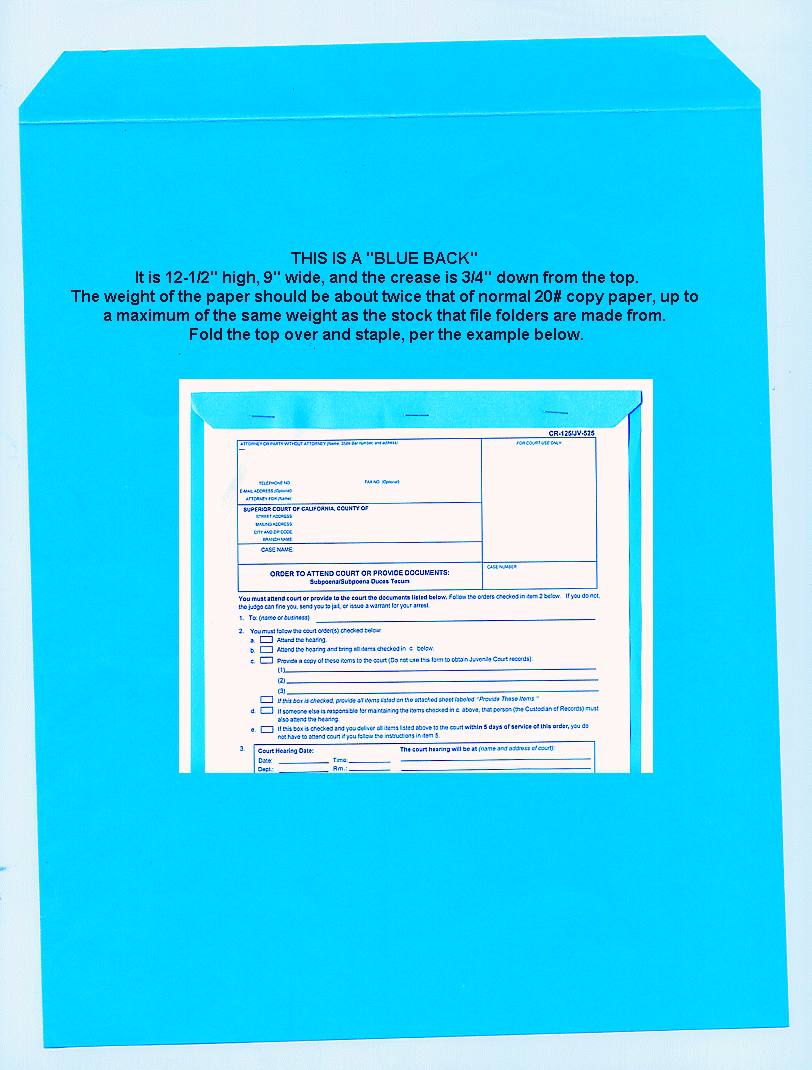
to
a
"blue
back"
(available
at
some
stationery
stores,
or
you can make one) so that whoever
you serve with the subpoena will be less
likely to lose track of it in the big pile of
paperwork on their desk. The blue back
will also make it less likely that that person
will accidentally lose the last page or some
other critical page of your subpoena.
CR-125 Form - Additional Important Info
The CR-125 form came out in July 2007 and is very different from previous forms - It doesn't ask you to provide a statement justifying your request for the materials.
On the CR-125 form, at the bottom of page 1, there is a 1" by 1" box labeled "For court use only." This box is for the window clerk to stamp his seal. While someone may tell you that it is not necessary to have the subpoenas stamped, I strongly recommend that you do so. The easiest way to get stamped subpoena forms is to ask the court clerk to mail some to you - if you have time. Otherwise, go visit the courthouse.
Also, the form doesn't make it perfectly clear who is to sign at the bottom of page 1. Is it the defendant, or is it the court clerk who stamped the subpoena for you? Some court clerks think that they are supposed to sign. I think it is the defendant. If you have asked the court clerk for subpoena forms, and the clerk has signed them at the bottom, I recommend that you place your signature down there too. And put your title, "in pro per," after your signature.
Finally, it is important to serve the subpoena on the right person. It's supposed to be the "Custodian of Records." If you are asking for police department records, it will be a supervisor or department head at the police department. If you are asking for city records that are not kept by the police (for example, a copy of the contract that the city council signed with the camera company), the right person to serve will usually be the city clerk. See Fight Your Ticket for more details.
Public
Records Act Requests
Filing a request under the California Public Records Act (Government Code Section 6250, the "CPRA") is an easy way to get documents from a government agency, but it's not always the recommended way if you need those documents for a court appearance because the traffic court cannot force the city to comply with a public records request, whereas it can enforce your Discovery and subpoenas (although quite reluctantly).
To view the rest of the CPRA, click:
Gov. Code
6250-6270.
You can file a CPRA
request anytime and as often as you want - whether or
not you have a case pending in court. CPRA
requests can be filed by mail, by fax, by email, or in
person. The government agency is required to reply
within 10 days, although they have the right to notify
you that it will take them some extra time (and
frequently do so).
(You may be able to obtain more than the twelve seconds of video the city will show in court. Some cities have access to 24/7 video from their red light cameras, for 90 days or so. To get, for example, the one minute of video surrounding your alleged violation, you could do a public records request. Or, you may need to use a subpoena to get it.)
Under the CPRA it doesn't matter why you want the documents. There is no "relevance" test, like there is with a subpoena.
Under the CPRA you can go to the government offices and look at the documents you inquired about, for free. But if you want copies to take home with you, you will have to pay roughly 10 to 20 cents a page for the copying. (If you plan to use those documents in court, you should ask the city clerk or the custodian of records to certify them.)
|
About
Certification
Certification is a rubber stamp, or an embossed seal, that the city clerk or custodian of records puts on your copy of the document, saying that it is a true copy of the original on file at their offices. On the stamp there's usually a blank for him or her to sign. I have noticed that even though I request cities to certify something, they often forget. So, when the copy is ready, I suggest that rather than having it mailed to you, you go pick it up so you can make sure that the certification has been done. They will charge 10 to 20 cents a page for making the copy, and they may charge a fee for doing the certification. |
The box immediately below contains a detailed discussion of copying cost. Refer to it if you feel that the government agency is overcharging you for copying documents.
|
Computing
the Cost of Copies in California
If, after I have
inspected the document at the counter I then ask
the clerk to make me a copy to take home, that
starts the clock for "direct costs of
duplication" - the agency can charge me for the
clerk's time while he or she is taking the
document from me at the counter over to the
copier, running it, and returning to the counter
- plus the "per copy" cost for paper, toner,
maintenance and electricity for the machine.
A.
Cost of clerk to walk to and from copier (.3 min. x $0.75)
0.23 B. Cost
of clerk setting-up copier (.5 min. x $0.75)
0.38 C.
Cost of clerk to feed the copier (.15
min. per copy x $0.75)
0.11 D.
Supply & maintenance of copier, per
sheet
0.03 Total cost to copy
each additional original: (C + D)
$0.14 |
A sample CPRA request is
below, in the bluish "wallpaper" area. You don't have to use
the City's standard form - if they have one.
In all but the largest
cities, give or send your CPRA request to the city clerk
at City Hall. The city clerk is not part of the
court system - so you will be treated nicely
there! In large cities, and counties, address your
request, by name, to the person who is second-in-command
in the appropriate department, usually Public
Works. The suggestion to address the request to
the second-in-command is because the top person is
usually inundated with official notices of all kinds,
and yours could get lost in the deluge.
If you have a case coming up soon in court, it probably is better to issue a Subpoena Duces Tecum, or file an informal Discovery, both covered on this page.
If the agency denies your request, the CPRA says that the denial has to be in writing.
6255. (a) The agency shall
justify withholding any record by demonstrating that the
record in question is exempt under express provisions of
this chapter or that on the facts of the particular case
the public interest served by not disclosing the record
clearly outweighs the public interest served by
disclosure of the record.
(b) A response to a written request for inspection or
copies of public records that includes a determination
that the request is denied, in whole or in part, shall
be in writing. (Emphasis added.)
Section 6255 also says
that the denial letter has to "express" (cite, say, or
state) what Section of the Public Records act justifies
the denial; or, the letter has to explain how the public
interest in keeping the information confidential is more
important than the public interest in exposing the
information to public view.
How Low Will They Go?
One city went public with
how it would like to handle public records
requests. To a statewide survey conducted in 2006
by the Chula Vista Police Department, the Roseville
Police Department posted the following on a public
website:
"The one annoyance is the people who have made
it their mission to fight photo red light citations by
making public records requests designed to annoy you and
create busy work. My recommendation is that you
save every related document somewhere and when you get
your first public records request you send them an
avalanche of paper and charge them accordingly."
If "your" police department is trying to "paper" you as
suggested by Roseville, keep in mind that you can inspect
records, for free. You only have to pay when you
ask for your own personal copy to take home with
you. (If you plan to use those
documents in court, you should ask the city clerk or the
custodian of records to certify them.)
Another example of a
City's efforts to keep information from the public is
this advice emailed to the City's of Bell's incoming
Chief of Police Randy Adams by Assistant City
Manager Pier'Angela Spaccia during the
2009 negotiation of the Chief's contract:
"We have crafted our
Agreements carefully so we do not draw attention to our
pay." "The word Pay Period is used and not defined in
order to protect you from someone taking the time to add
up your salary."
In 2014 Ms. Spaccia was
sentenced to 11 years in jail.
As shown by the
publication of the embarrassing emails from Bell, the
emails exchanged among city staff, councilmembers and
the public are public information. Except
when they involve attorney-client privilege. Even
when the councilmembers use their personal (non-city)
email address to conduct city business, those emails
may be public. Some cities are balking at
forcing their councilmembers to turn over those emails;
a suit (San
Jose v. Superior Court (Smith)) which reached the
Cal. Supreme Court in June 2014 may clarify the
situation.
The 2012 settlement in another suit (First
Amendment Coalition v. City of Auburn) may also
help to clarify that the Govt. Code Sec. 34090(d)
requirement for government records to be retained for
two years is applicable to emails, which will end the
now-common practice of destroying emails after a
few days or weeks.
In 2015 the Alameda County Grand Jury told
the City of Fremont that it must cease its practice of
destroying emails after 30 days.
The very best book about
the CPRA is The CalAware Guide to Journalism
Law in California. See the Reference
section on the Links page for details about it.
A two-page summary of the
CPRA is available here.
One agency's public
records manual is available here.
Hearsay
If you are going to the
trouble of obtaining documents, make the small
additional effort to make sure they will be admissible
in court. Documents you obtain from
non-government sources are hearsay and cannot be used as
evidence in court unless you bring in the person who
created them, to answer the opposition's questions about
the documents. However, documents created
by a government employee can come into evidence without
having the government employee present - because
there is an exception to the hearsay rule for documents
created by a government employee in the normal course of
their job. The documents need to be certified,
though.
| Evidence Code
1280. Evidence of a writing made as a record
of an act, condition, or event is not made
inadmissible by the hearsay rule when offered in any
civil or criminal proceeding to prove the act,
condition, or event if all of the following applies: (a) The writing was made by and within the scope of duty of a public employee. (b) The writing was made at or near the time of the act, condition, or event. (c) The sources of information and method and time of preparation were such as to indicate its trustworthiness. |
| SECTION 1. Section 1552 of the
Evidence Code is amended to read: 1552. (a) A printed representation of computer information or a computer program is presumed to be an accurate representation of the computer information or computer program that it purports to represent. This presumption is a presumption affecting the burden of producing evidence. If a party to an action introduces evidence that a printed representation of computer information or computer program is inaccurate or unreliable, the party introducing the printed representation into evidence has the burden of proving, by a preponderance of evidence, that the printed representation is an accurate representation of the existence and content of the computer information or computer program that it purports to represent. (b) Subdivision (a) applies to the printed representation of computer-generated information stored by an automated traffic enforcement system. (c) Subdivision (a) shall not apply to computer-generated official records certified in accordance with Section 452.5 or 1530. SEC. 2. Section 1553 of the Evidence Code is amended to read: 1553. (a) A printed representation of images stored on a video or digital medium is presumed to be an accurate representation of the images it purports to represent. This presumption is a presumption affecting the burden of producing evidence. If a party to an action introduces evidence that a printed representation of images stored on a video or digital medium is inaccurate or unreliable, the party introducing the printed representation into evidence has the burden of proving, by a preponderance of evidence, that the printed representation is an accurate representation of the existence and content of the images that it purports to represent. (b) Subdivision (a) applies to the printed representation of video or photographic images stored by an automated traffic enforcement system. |
See also Defect # 10 - D
on the Home page, the Goldsmith
and Annette B. cases, and SB 1303 on the
Action/Legis page.
Bureaucratic
Tricks
If that happens to you, remind the city that the city paid for the camera company (or the sheriff) to create and maintain the records and as a result the records are the city's property (and responsibility to disclose) even if they are located off city premises at the camera company (or sheriff's office).
There's another reason not to request or accept records directly from the camera company. The records you get will be hearsay, and useless in court, because they were obtained from a private entity, not a government agency. (See Hearsay, above.)
Traffic Accident Statistics
If you want to know how many accidents have occurred at a particular intersection, you can get that information from SWITRS - the Statewide Integrated Traffic Records System. SWITRS reports are available to cities and private individuals (you), at no cost, from the Information Services Unit of the CHP.
(To get a report, go to their website at http://iswitrs.chp.ca.gov. Please note, however, that SWITRS will automatically send the City a copy of whatever they have provided to you.)
Examples of their reports are in Set # 12 of Culver City Documents and in Set # 5 of Hawthorne Documents.
1. Public Records Request
2. Discovery
To copy one of the forms below -
1. Highlight the text of the form you want, below
(for technical reasons, they're in the bluish
"wallpaper" area).
2. Copy that highlighted text into a blank word
processor document [control-C, start Word, control-V].
3. If the
resulting word processor document has a lot of short
broken-up lines of text or won't fit onto a single 8-1/2
x 11 page, try the following settings:
(a) display
at "full screen,"
(b) fixed-width font such as Courier New, 12
points or less,
(c) smaller side margins.
4. Any item full of XXX's or 999's will require changing or
editing, and the lines beginning with XXX may require
changing or filling-in. After you're done editing the document, do a 'find' or 'search' for
XXX and another for 999 - to make sure that you have
found all the items that must be changed or
filled-in.
---------------------------------
RED LIGHT
CAMERAS
www.highwayrobbery.net
www.highwayrobbery.net
(Scroll Down for the Forms)