|
Popular links from this page: Contact/Email Address Journalists/Bloggers/Webmasters Legislation/Speed Cameras Coming? Industry PR - and Ours Boycott ! |
Quick links to info on other highwayrobbery.net pages: Fake/Snitch Tickets Issued by Police FAQ Frequently Asked Questions Alternatives to Cameras Library of Transcripts, Briefs, Decisions Search |
“A nation of sheep will beget a government of wolves.”
Edward R. Murrow, CBS Journalist & War Correspondent 1908 - 1965
If you've just arrived at highwayrobbery.net, please start by reading the What's Hot box on the Home page.
On this Action page - scroll down, or click on these links:
1. Recent, Current & Future Legislation & Elections: 2010 - 2022
1.5 Info About Contacting Your Legislators
2. An Initiative
3. You Don't Have to Shop There... (Boycott!)
4. More Things You Can Do
4.5 Info for Journalists / Industry PR
5. Donations
6. Older Legislation: 1994 - 2009
6.5 Humor
7. The Guru Club
8. Ticket Questionnaire and Email Address
highwayrobbery.net is a free-of-charge public service.
1. 2010 - 2022 Legislation & Elections
The current two-year session runs from Jan. 2021 to Sept. 2022.
Legislation from previous years is discussed further down this page.
You can get a Charlie Brown
mug at peanuts.store
Our Legislature is just pretending to want red light camera reform.
2021
- 2022 (Active!) Legislation
2021 - 2022 Legislation, # 1 of 3
Speed Cameras / Photo Radar (Opposed - Bill Failed in 2021, May Be Back in 2022)
Our comments as of 5-27-21
If AB
550 eventually passes, photo radar (speed cameras) will be
installed in California.
In past years there's been seven attempts to OK speed
cams. The 2021 attempt failed, but the bill could come back for
consideration in early 2022. AB 550 was just one of two speed camera bills submitted in 2021; the other, SB
735 also failed.
Here are some of the things wrong with AB 550.
1. The bill was being promoted as limited to
school zones, but the fine print of the bill allowed
the cameras to be installed up to 2500 feet away from
schools, parks and rec centers, yielding multiple one mile diameter circles
all over town. In the official
analysis of the similar (also failed) SB 735 the Legislature's staff
analyst wrote:
"The bill proposes that the school [and park, etc.] zone
extend as much as 2500 feet beyond the school boundary
in every direction. This is far beyond
the existing school zone boundary of 500 feet where a
15 mph limit applies and well past where
students would have dispersed.
The bill allows the automated enforcement to be
activated seven days a week, twenty four hours a day [the hours
around schools will be limited]."
2. Then there was the question of the sponsors'
motivation. Was it about safety, or money?
In the official analysis of SB 735, the Legislature's
staff analyst also wrote:
"What's the evidence? There's little official
evidence about traffic accidents in school zones in
California. The California Highway Patrol's
traffic accident database does not record accidents
with that detail so we have no evidence as to the
number of school zone accidents or whether those
numbers are increasing."
3. As occurs now with red light camera tickets, the 1.5 million+ government employees (and their parents and children) who enjoy California's confidential/protected plate privilege are likely to escape ticketing by the proposed speed cameras. In most cities presently having red light cameras, camera tickets already are the majority of all motoring tickets issued; for example, in 2019 Beverly Hills issued 19,789 red light camera tickets and only 6958 signed/live citations. If speed camera tickets are added to the mix, an ordinary motorist will receive several times as many tickets as a motorist having confidential plates.
4. AB 550 made racial and geographic profiling easy, and nearly impossible to detect. To prevent profiling, photo enforcement legislation needs to include a requirement that the name, address and face photo (if one is taken) of the registered owner or driver not be visible to the city or county personnel making the final decision whether the ticket is to be issued, or not.
5. Under AB 550, the tickets would not show on a motorist's license, and all
program data would be secret. So, a motorist could commit
unlimited incidents of speeding (so long as she or he pays the tickets), until someone is killed.
The
data secrecy also eliminates the ability of the public or the press to obtain monthly
location-by-location printouts - like the red light camera reports
published here on highwayrobbery.net - showing the number of tickets issued.
Detailed Public
Criticism of AB 550
Two of the co-authors of AB 550 - Wiener and Chiu -
were also co-authors of the (failed) photo radar
legislation in 2017.
Please let your legislators and councilmembers know
that you are opposed to photo radar. To see another
of the reasons why everyone - even those who never
speed - should oppose photo radar, read our
investigation of the setting of speed limits in the
City of Fremont - see Table 2 in Set # 1 on the Fremont Docs
page.
Phone numbers and info about the legislative process,
are available in the big purple box, below.
2021 - 2022 Legislation, # 2 of 3
Lowers All Local Speed Limits - Nullifying
the Speed Trap Law (Active Bill - Oppose)
Our comments as of 5-27-21
For more than five decades the Speed Trap Law (CVC 40801) has protected California motorists against unfairly low speed limits. If it passes, AB
43 will end that protection by allowing local speed limits to be set 5 mph lower than the speed limit
recommended by the engineer in his survey - with limits as low as
15 mph.
Phone numbers and info about the legislative
process, are available in the big purple box, below.
2021 - 2022 Legislation, # 3 of 3
Legalizes
Jaywalking! (Active Bill - Oppose)
Our comments as of 5-27-21
AB
1238 will remove the rules that presently require
pedestrians to cross streets in a cross walk and not
against the signal. If the bill passes, a motorist who hits a
pedestrian who is jaywalking, crossing against the
light or wandering aimlessly in the middle of the street, will be at fault.
Phone numbers and info about the legislative
process, are available in the big purple box, below.
You are on the Action/Legis page.
|
How To Influence Legislators Call Your Auto Club CSAA - Northern California: Start by calling the customer service # on your membership card. If that doesn't work, call corporate headquarters in Emeryville, at (510) 596-4840. And if that doesn't work, call the joint CSAA/ACSC Legislative Counsel office in Sacramento, at (916) 594-7348. ACSC - Southern California: Start by calling or visiting the Club's local office or by calling the customer service # on your membership card. If that doesn't work, call corporate headquarters in Orange County at (714) 885-1222 and ask for Legislative Affairs. If that doesn't work call the joint CSAA/ACSC Legislative Counsel office in Sacramento, at (916) 594-7348. If you have trouble contacting anyone at your club in California, call AAA National Headquarters in Florida: Executive Office (407) 444-7000 Public Affairs in Washington, DC (202) 942-2050. Manager, Public Relations (202) 942-2082 |
LA - Area Voters:
In 2022, Vote No on Sheila Kuehl
Sheila Kuehl is one of the five LA County Supervisors.
In 2014 Supervisor Zev
Yaroslavsky "termed out." (He
represented the central and western San Fernando Valley, Malibu,
Santa Monica, Venice, Beverly Hills, the City of West
Hollywood, and part of Hollywood.)
Sheila Kuehl won the 2014 election to succeed Zev, by a narrow margin.

Sheila "Kuehl Cams" Kuehl, in 2007
Kuehl is a career politician. During her time in the California
Legislature, Kuehl wrote and sponsored three bills
( SB 1325 of 2008 SB 1300 of 2006 SB 466 of 2005 ) attempting to allow
the use of automated speed enforcement (photo radar) in California. (There is another attempt in 2021 - see below.)
As an LA County Supervisor, she has a seat on the
MTA/Metro board and she has been a vote to continue and
expand Metro's huge (101 cameras, so far) red light camera
system.
In 2016 she voted to put an additional sales tax, to go to Metro, on the Nov. 2016 ballot, and it passed. (See Measure M below for more about that tax.)
She may be up for re-election in Nov. 2022.
East Bay Voters:
Do you live in the South end of Alameda
County or the North end of Santa Clara County - State
Sen. Ellen Corbett's former District?
In 2014 Sen. Corbett "termed out," and has been replaced by this person
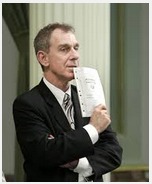
Wieckowski, Author of the
anti-motorist bills SB-1 and AB
666
who will be running for re-election in 2022.
Please don't vote for him.
Send him back home to his bankruptcy
law practice.
He was a co-author of SB-1 of 2017 (it raised the gas tax and car registration fees). In 2013 he was the author of AB-666 which - had it passed - would have increased the number of red light camera tickets. Before reaching the Legislature he was a member of the Fremont City Council, and during his time on the council he approved two extensions of Fremont's contract with RedFlex: He was the maker of the 2005 motion to extend the contract to 2010, and in 2010 he made the motion to extend the contract to June 2017.
2017 - 2018 Legislation
2017 - 2018 Legislation, # 1 of 6
Speed Cameras / Photo Radar (Opposed, Failed to Pass in 2017 - 2018, Back in 2021)
New 11-26-16, updated 8-29-18
In Feb. 2017 a bill (AB 342) was filed to allow the use of photo radar (speed cameras) in California. It failed to gain approval in 2017, but it came back in 2021 - see above.
There's been six previous attempts, just in the last ten years, but the 2017 attempt was far better organized and planned and had two large cities backing it.
The proposed law, AB 342 (Chiu, San Francisco) was written by the cities of San Francisco and San Jose, and as filed in 2017 would have restricted the cameras to just those two cities. But it is likely that if the bill is re-launched in 2019, other large and small cities will ask to be added; two of the co-authors of the bill represent a number of medium size cities near San Jose and there are Vision Zero programs in Los Angeles and San Diego.
Nov. 2016 Article
May 18, 2015 Article
May 31, 2015 Article
Three of Assemblymember Chiu's co-authors on AB 342 were authors or co-authors of other current anti-motorist bills discussed below; Sen. Weiner authored SCA 6 and co-authored SB 1 (which was signed into law by Gov. Brown on Apr. 28, 2017 and raised your motoring taxes) and SB 185, Sen. Wieckowski co-authored SB 1 and SB 185, and Sen. Beall authored SB 1 and co-authored SB 185.
Hertzberg
Chu
Wiener
Wieckowski
Beall
Chiu
Galgiani
Van Nuys
Mil-
pitas
SF
Fremont
San Jose
SF
Modesto
Did It Pass?
AB 342 - speed cams
co
co
co
auth
No
SB 1 - gas and regis. tax
co
co
co
auth
Yes
SB 362 - more confid. plates
auth
No
SB 185 - fine reduction for the indigent
auth
co
co
co
co
co
No
SCA 6 - easier tax increases
auth
No
Please let your legislators and councilmembers know that you are opposed to photo radar and any new version of AB 342. To see one of the reasons why everyone - even those who never speed - should oppose photo radar, read about the newly exposed corruption in the City of Fremont - see Table 2 in Set # 1 on the
Fremont Docs page.
Phone numbers and info about the legislative process, are available in the big purple box, above.
2017 - 2018 Legislation, # 2 of 6
Introduced 2017, Re-introduced 2018: SB 493 and SB 1132 - Lower Fine for Rolling Right Turns (Failed: Strong Support Is Needed Next Time)
New 2-20-17, updated 8-29-18
SB 1132 (Hill)
would have reduced the fine for rolling a right turn to (approx.) $300. It replaced SB 493, the 2017 version of
the bill, which failed to pass. SB 1132 did not pass; like SB 493, it was held up in the Assembly Appropriations Committee. Any new bill will suffer the same fate unless the motoring public starts phoning their legislators about it, writing letters to the editor about it, etc.
SB 1132 was the sixth attempt to reduce the fine for rolling right turns. The earlier attempts were in 2010, 2012, 2015, 2016 and 2017.
The 2017 bill, SB 493, was filed on Feb. 16, 2017, and after receiving unanimous "aye" votes in three Senate committees and on the Senate floor it moved to the Assembly where it got "held" (stopped) in the Assembly Appropriations Committee, thus could not move ahead in 2017.
SB 493 was the new version (with some changes) of 2016's SB 986, which also failed to pass, for the exact same reason - the Assembly Appropriations Committee held it.
SB 986 failed either due to the (exaggerated and distorted) safety concerns
voiced by the pedestrian lobby, or due to revenue
concerns voiced by
the big government lobby. You be the judge.
Had either SB 1132, SB 493 or SB 986 made it through those committees on time, it would have gone to a
vote by the whole Assembly, and then to Gov. Brown. It is hard to tell if
he would have signed it, or vetoed it. His Finance Department representative
said, at an Apr. 18, 2016 hearing on SB 986, "We don't think that the fine is
unreasonable." In other words, the governor wanted to keep the fine
money high, to help balance the California budget. But other opinions
were that he liked the bill and would have signed it into law.
SB 1132, SB 493 and SB 986 were supported by both California AAA auto clubs.
For more information about the effort to lower the fine for right turns, see AB 909 of 2010, below.
Phone numbers and info about the legislative process, are available in the big purple box, above.
2017 - 2018 Legislation, # 3 of 6
Five Bills to Add Even More Govt. Employees' Private Vehicles to Protected Plate List (All Opposed - Two Passed)
New 11-26-16, updated 8-29-18
We don't know the current count, but by 2011 there already were more than 1-1/2 million private vehicles belonging to government employees and their families (children, parents), with license plate numbers protected from easy or efficient look up, making those vehicles' owners effectively invisible to agencies attempting to process parking, toll, and red light camera violations.
During the second half of the 2017 - 2018 session, AB 3017 (Acosta), SB 1093 (Jackson) and AB 2322 (Daly) attempted to make the protected plate privilege available to even more government employees.
Only AB 2322 passed, and it was fairly innocuous as it clarified protection for judges, commissioners and their families.
During the first half of the 2017 - 2018 session, SB 362 (Galgiani) and AB 1418 (O'Donnell) attempted to expand the privilege.
Only AB 1418 passed, and it was fairly innocuous as it clarified that the existing protection for city attorneys would apply to city prosecutors.
During the second half of the 2015 - 2016 session, SB 1131 (Galgiani) attempted to add meter maids and code enfocement officers to the protected list.
During the first half of the 2015 - 2016 session, AB 222 (Achadian) attempted to add state hospital employees to the protected list. The Legislature's official analysis of AB 222 listed other
2015 and earlier bills which attempted to add more employees to the protected list.
"When a few leaders are so able to insulate themselves from everybody else... that has a corrosive effect."
Capt. Chesley "Sully" Sullenberger, on the Tavis Smiley show, 6-15-12.
There's no dispute that many government employees need protected plates, but highwayrobbery.net opposes any attempt to further expand the protected plate privilege, because the Legislature has refused to enact a requirement for a protected employee to give
the DMV a service address (typically his or her employer's address) for the mailing of the employee's and his or her family's toll and red light camera and toll violations. In 2013, 2012, 2011 and 2010 there were bills which would have made that a requirement, but none of them passed.
Please let your legislators know that you oppose the further expansion of protected/confidential plate
privileges until a bill has passed to require protected employees to give the DMV a service address for their traffic tickets.
For more information about protected plates, see FAQ # 22.
Phone numbers and info about the legislative process, are available in the big purple box, above.
2017 - 2018 Legislation, # 4 of 6
Senate Bill 185: Reduction of Fines for Indigent Drivers, with a Catch (Opposed Strongly, Failed to Pass in 2017 - 2018, May Be Back in 2019)
New 4-9-17, updated 8-29-18
SB 185 (Hertzberg) appeared on its surface to simply be about the reduction of infraction fines for the indigent, but there was much more hidden in the bill's 6000 words.
The catch was that Sections 7 and 9 of the bill would have turned a motorist's failure to respond to a mailed red light camera ticket into an additional infraction count for
failure to appear - something that would have had a significant effect in those counties (example: Los Angeles County) where the courts have chosen, so far, not to clog up their calendars with thousands of traffic cases involving minor transgressions.
Further, any bill giving motorists a break on fines for minor transgressions should only
do it when the motorist has otherwise behaved responsibly, including carrying insurance. With this bill, California will be sending the message: No license, no insurance, no registration, bad driver, welcome to California.
Sen. Hertzberg and three of his co-authors on SB 185 (Weiner, Wieckowski, Beall) also authored or co-authored SB 1, which raised your motoring taxes - and was signed into law by Gov. Brown on Apr. 28, 2017.
Phone numbers and info about the legislative process, are available in the big purple box, above.
2017 - 2018 Legislation, # 5 of 6
Senate Constitutional Amendment 6: Facilitating All Kinds of Tax Increases, Not Just on Cars (Opposed Strongly, Failed to Pass in 2017 - 2018, May Be Back in 2019)
New 11-26-16, updated 8-29-18
SCA 6 (Weiner)
would have paved the way for repeated tax increases around California. The bill would have lowered the number of voters it takes to approve a new tax, from the present 66% down to 55%. The bill was a "game changer." Had it passed, Californians would have seen major tax increases on every ballot, forever, for road building and repairs and public transit - things we already are paying for through recently increased gas taxes (see SB 1, below) and sales taxes. SCA 6 was opposed by the Association of California Life and Health Insurance Companies, the California Taxpayers Association, the California Association of Realtors, the California Bankers Association, the Howard Jarvis Taxpayers Association (read their guest editorial), the National Federation of Independent Businesses, the Orange County Taxpayers Association, and the Western States Trucking Association.
Sen. Weiner was a co-author of AB 342 (photo radar), SB 185 (fine reduction, with a catch), and SB 1, which raises your motoring taxes - and was signed into law by Gov. Brown on Apr. 28, 2017.
SCA 6 was a repeat of ACA 4 of 2016, which failed to pass. Please let your legislators know that you oppose any bill like this.
Phone numbers and info about the legislative process, are available in the big purple box, above.
2017 - 2018 Legislation, # 6 of 6
Higher Gas Tax and Car Registration Fees - and a $1 Billion Backroom Deal (Opposed, Passed and Signed by Governor), attempted repeal was Prop. 6 on Nov. 6, 2018 Ballot
New 2-8-17, updated 1-15-19
SB 1 (Beall, San Jose) was a repeat of Beall's bill from the 2015 - 2016 session, SB 16
which, had it passed, would have raised the gas tax and car registration fees. SB 1 was filed in Dec. 2016 and on Apr. 28, 2017 was signed into law by Governor Brown.
Commentary by a State Legislator:
"U.S. News recently released a report ranking all of the states
on budget transparency. Where did California rank on that list?
Dead last — 50 out of 50. The entire study was based on one simple
and common sense metric: how easily the public can access the state’s
spending data. This is deeply concerning in light of Sacramento’s
passage of the largest gas tax in state history.
"This proposal, which I strongly opposed, will put in place a
12 cent gas tax increase, a 20 cent diesel tax increase, and an
increase in the vehicle license fee by up to $175 per vehicle. However,
the governor has not yet signed this bill [editor's note: Gov. Brown
signed SB 1 on April 28, 2017] because he is waiting for
the passage of a separate budget bill that includes $1 billion in
backroom deals in order to jam through these major tax increases.
"This budget bill is expected to be taken up on Monday and will be
rushed through the Legislature as well. This epitomizes what is wrong
with Sacramento and the ugliness of the status quo that breeds distrust
of our government. This entire process shows the need for real budget
transparency.
"The transportation crisis was created by Sacramento because they
neglected our highways and roads for decades by diverting billions of
transportation fund dollars to the general fund to be spent on
non-transportation related items. Now Sacramento is making California
residents pay more by imposing more gas taxes and vehicle fees on top
of one of the highest-in-the-nation gas taxes motorists are already
paying at the pump."
Assemblyman Vincent Fong in 4-23-17 guest editorial in the Bakersfield Californian.
SB 1 was opposed by the Southern California AAA Auto Club, the Agricultural Council of California, the Bicycle Coalition, the California League of
Conservation Voters, California Walks, the Howard Jarvis Taxpayers Association, Move LA, the Prevention Institute, the Safe Routes to School
National Partnership, and the California Sierra Club.
Sen. Beall was a co-author of AB 342 (photo radar) and SB 185 (fine reduction, with a catch).
Prop. 6 on the Nov. 6 ballot was an attempt to undo the SB 1 tax increase, but it failed to pass. The "yes" vote was 43%.
Please let the governor (and your legislators) know that you
oppose any further tax increase bills like SB 1. And let Pres. Trump know that you oppose his proposed increase in the federal gas tax.
Phone numbers and info about the legislative process, are available in the big purple box, above.
Previous Legislation - 2010 - 2016
Legislation from 2009 and before is discussed in Section 6, further down this page.
2015 - 2016 Legislation
2015 - 2016 Legislation, # 1 of 10
Introduced 2016: SB 986 - Lower Fine for Rolling Right Turns (Support) (Failed)
New 1-5-16, updated 8-12-16
SB 986 (formerly SB 681) (Hill)
would have reduced the fine for rolling a right turn to (approx.) $300.
SB 986 was approved in the State Senate on May 31 (unanimously!) and then went to the Assembly where it needed to be passed by two committees, by Aug. 12. The Transportation Committee approved it (unanimously!) but the Appropriations Committee did not approve it - they held it in "suspense." SB 986 failed either due to the (exaggerated and distorted) safety concerns voiced by the pedestrian
lobby, or due to revenue
concerns voiced by the big government lobby. You be the judge.
Had the bill made it
through those committees on time, it would have gone to a vote by the whole Assembly, and then to Gov. Brown. It is hard to tell if he would have signed it, or vetoed it. His Finance Department representative said, at an Apr. 18 hearing on the bill, "We don't think that the fine is unreasonable." In other words, the governor wants to keep the fine money high, to
help balance the California budget. But other opinions are that he liked the bill and would have signed it into law.
SB 986 was supported by both California AAA auto clubs.
SB 986 was the fourth attempt to reduce the fine for rolling right turns. The earlier attempts were in 2010, 2012 and SB 681 of 2015. For much more information about the effort to lower the fine for right turns, see AB 909 of 2010, below.
Phone numbers and info about the legislative process, are available in the big purple box, above.
2015 - 2016 Legislation, # 2 of 10
Rumored: Speed Cameras / Photo Radar (Watch Out in 2019!)
New 8-14-14, updated 6-4-16
It looks like in the 2015 - 2016 session there will be another attempt to approve the use of photo radar in California.
There's been six previous attempts, just in the last ten years.
The new attempt may come out of San Francisco, where the Vision Zero Coalition is working for changes in state law to allow the automated enforcement of speeding.
May 18, 2015 Article
May 31, 2015 Article
Even though now it is fairly late in 2016, it is possible that a San Francisco legislator could try to sneak in a bill at the last minute. So, please let your legislators know that you are opposed to photo radar.
Phone numbers and info about the legislative process, are available in the big purple box, above.
2015 - 2016 Legislation, # 3 of 10
Introduced 2015: AB 222 - Add More Govt. Employees' Private Vehicles to Protected Plate List (Oppose)
New 5-5-15, updated 6-4-16
AB 222 (Achadian) will make the protected plate privilege available to even more government employees. There's already 1-1/2 million private vehicles, belonging mostly to government employees and their families, with license plate numbers protected from easy or efficient look up, making those vehicles' owners effectively invisible to agencies attempting to process parking, toll, and red light camera violations. This bill will add State hospital employees to the already long list of those eligible.
"When a few leaders are so able to insulate themselves from everybody else... that has a corrosive effect."
Capt. Chesley "Sully" Sullenberger, on the Tavis Smiley show, 6-15-12.
Highwayrobbery.net opposes this bill because there is no requirement for protected employees to give
the DMV a service address (typically their employer's address) for the mailing of toll and red light camera violations. In 2013, 2012, 2011 and 2010 there were bills which would have made that a requirement, but none of them passed.
AB 222 did not pass by the 9-11-15 deadline, but it may come back alive in 2016, and something like it will be back every year in the future. (The
official analysis of this bill lists other
recent bills which attempted to add more employees to the protected list.) So please let your legislators know that you oppose to any expansion of confidential plate
privileges until a bill has passed to require protected employees to give the DMV a service address.
For more information about protected plates, see FAQ # 22.
Phone numbers and info about the legislative process, are available in the big purple box, above.
2015 - 2016 Legislation, # 4 of 10
Introduced 2015: SB 16 - Higher Gas Tax and Car Registrations Fees - Including $100 for Zero Emission Cars (Oppose - Stopped for Now)
New 5-26-15, updated 9-13-15
SB 16 (Beall)
will raise the gas tax and car registration fees. This bill is opposed by the Howard Jarvis Taxpayers Association.
As of 9-13-15 this bill had failed to make it out of the Senate. But it could come back in 2016.
Phone numbers and info about the legislative process, are available in the big purple box, above.
2015 - 2016 Legislation, # 5 of 10
Introduced 2015: ACA 4 - Facilitates Tax Increases (Oppose - Stopped for Now But WATCH OUT)
New 5-25-15, updated 9-13-15, 6-4-16
ACA 4 (Frazier and Wolk)
will pave the way for repeated tax increases around California. The bill will do that by lowering the number of voters it takes to approve a new tax, from the present 66.6% down to 55%. This bill is a "game changer." If it passes, you will see tax increases every time you vote, for the rest of your life, for road building and repairs, and public transit - things you already are paying for through gas tax and sales tax on gasoline. This bill is opposed by the California Chamber of Commerce, California Taxpayers Association, Associated Builders and Contractors of California, California Association of Realtors, California Retailers Association, Orange County Business Council, Howard Jarvis Taxpayers Association (read their guest editorial), National Federation of Independent Businesses, and the Orange County Taxpayers Association.
Because this bill amends the California Constitution (it is an Assembly Constitutional Amendment), you have two opportunities to oppose it. Right now, you can contact your legislators and ask them to vote against it. And then, if it makes it to the Nov. 2016 ballot, you can oppose it when you go to the polls.
As of 9-13-15 this bill had failed to make it out of the Assembly. But it could come back alive in 2016, with little warning. So please let your legislators know that you oppose this bill.
Phone numbers and info about the legislative process, are available in the big purple box, above.
2015 - 2016 Legislation/Elections, # 6 of 10
On Your LA County Ballot in Nov. 2016: Measure M - Even More Sales Tax for Metro (Oppose) (Passed by Voters)
New 1-6-16, updated 11-9-16
In Nov. 2016 there was a sales tax increase (Measure M) on the ballot in LA County, with some of the money to go to local cities (as a bribe) and most of the money to go to Metro/MTA - which already gets so much sales tax that it had to get special permission from the State Legislature (via SB 767) to ask for more. When you are deciding how to vote on future tax requests by Metro, remember the $500.00 Metro or one of those cities forced you to pay for your Mickey Mouse red light camera ticket.
And remember that 1/5 of the sales tax you already pay goes to Metro - $2 on every $100 purchase.
Phone numbers and info about the legislative process, are available in the big purple box, above.
2015 - 2016 Legislation, # 7 of 10
Introduced 2015: SB 632 - Larger and 24 x 7 School Zones (Oppose - Stopped for Now)
New 4-7-15, updated 9-13-15
SB 632 (Cannella, Baker, Bonilla)
will expand the reduced speeds of 25 or 15 mph in school zones to an unlimited distance from the schools and will allow them to operate 24 hrs/day, 7 days/week, 365 days/year.
As of 9-13-15 SB 632 had failed to make it out of the Senate. But it could come back in 2016.
This bill is opposed by the Automobile Club of Southern California. Also, Safer Streets LA did a report highly critical of the bill. Please read the SSLA report and then contact your legislators.
Phone numbers and info about the legislative process, are available in the big purple box, above.
2015 - 2016 Legislation, # 8 of 10
Introduced 2015: SB 218 - Abolish Stop Sign Cameras (Support - Stalled in May 2015)
New 4-12-15, updated 9-13-15
SB 218 (Huff)
will stop the use of stop sign cameras, possibly including those presently operated by the MRCA.
As of May 2015 this bill's progress through the Legislature was stalled.
Phone numbers and info about the legislative process, are available in the big purple box, above.
2015 - 2016 Legislation, # 9 of 10
Likely in 2016: Push for Collection of Unpaid Fines (Watch)
New 12-8-14, updated 1-6-16
In late 2014 a new effort began to start a pilot program to give the courts a greater incentive to pursue the collection of fines.
One prong of that effort is the new amnesty - see SB 405, next. But we still could see another bill upping the courts' financial incentives (a bigger cut of the fine money?) to pursue motorists who have not responded to red light camera tickets, or a bill like AB 2147 of 2012 (described below) which if it had passed would have required the court to issue bench warrants.
Phone numbers and info about the legislative process, are available in the big purple box, above.
2015 - 2016 Legislation, # 10 of 10
Introduced 2015: SB 405 - Amnesty (Support - Passed & Signed into Law)
New 4-11-15, updated 9-30-15
SB 405 (Hertzberg)
provides a partial amnesty on some tickets. The amnesty "discount" is as much as 80% for persons with low income.
The amnesty was mentioned in Gov. Brown's budget - see pages 51 - 52. Brown estimates it will generate $150 million for the State.
A related report, published in June 2015, is "Not Just a Ferguson Problem - How Traffic Courts Drive Inequality in California"
Phone numbers and info about the legislative process, are available in the big purple box, above.
2013 - 2014 Legislation
2013 - 2014 Legislation, # 1 of 7
Introduced 2014: AB 2487 - No More Trial de Novo (After Trial by Declaration) (Opposed - Bill Failed)
New 6-11-14, updated 7-5-14
AB 2487 (Wagner)
would have eliminated the right to a Trial de Novo after a Trial by Declaration.
AB 2487 was actively moving through the legislature until June 24 when a 3 - 4 vote by the Senate Public Safety Committee stopped it.
Assemblymember Wagner's 6-11-14 Fact Sheet said:
"Rather than providing a convenient way for a traffic violator who lives an impractical or inconvenient distance from the court to
contest matters, the process is being used to give a second bite at the apple to win a case."
"AB 2487 increases the efficiency of traffic courts by amending CVC 40902 to require defendant accused of most CVC infractions to choose either
a trial by written declaration, or a hearing, but not both."
Phone numbers and info about the legislative process, are available in the big purple box, above.
2013 - 2014 Legislation, # 2 of 7
Introduced 2014: AB 1767 - Higher Fines at MRCA Stop Sign Cameras (Strongly Oppose) - Signed by Governor
New 5-10-14, updated 6-24-14, 7-2-14, 9-5-14 and 9-30-14
AB 1767 (Holden)
will allow the MRCA parks district to increase the fines from their LA area stop sign cameras - presently $100 - to as much as $500. And then if that wasn't bad enough, a last minute (July 2) amendment will change the MRCA's stop sign tickets from an infraction to a misdemeanor. (You can get jail time for a misdemeanor, and having one on your record can affect your ability to get a job, or keep the one you have.)
AB 1767 was launched in Feb. 2014 and was signed into law by Gov. Brown on Sept. 25.
Go here for more info about the MRCA.
Phone numbers and info about the legislative process, are available in the big purple box, above.
2013 - 2014 Legislation, # 3 of 7
Introduced 2013: AB 612 - Longer Yellows (Supported - Withdrawn by Author, Then Changed to Non-Red Light Camera Subject)
Updated 6-5-14
AB 612 (Nazarian)
would have added 1 second to the length of yellow lights.
AB 612 was launched during the 2013 session, but did not pass. In June 2014 the author changed the bill to deal with a non-red light camera subject, the rules governing charter-party carriers.
(For more info about longer yellows, see the Alternatives page.
Phone numbers and info about the legislative process, are available in the big purple box, above.
2013 - 2014 Legislation, # 4 of 7
Introduced 2013: AB 487 - Reforming "Protected Plates" (Support - Withdrawn by Author)
Updated 4-13-14
AB 487 (Linder) was the fourth attempt to require the holders of 1.5 million "protected plates" to give
the DMV a service address for the mailing of toll and red light camera violations. AB 487 was launched in 2013, but did not pass.
The California AAA clubs took a neutral position on the 2012 edition of this bill. Please urge them to stand up for motorists. Phone numbers and info about the legislative process, are available in the big purple box, above.
"When a few leaders are so able to insulate themselves from everybody else... that has a corrosive effect."
Capt. Chesley "Sully" Sullenberger, on Tavis Smiley show, 6-15-12.
(For more info about protected plates, see AB 2192 in the 2012 Legislation section, further down this page, and FAQ # 22.)
2013 - 2014 Legislation, # 5 of 7
Introduced 2013: Assembly Bill 666 - The Ultimate Industry Bill (Opposed & Defeated)
Updated 4-13-14
AB 666 (Wieckowski), was
advertised as red light camera reform but actually would have made things much worse for motorists, and much better for the Industry. Read about it on the SaferStreetsLA.org website - and call your legislators - just so this bad idea won't come back as part of another bill.
And if you live in the East Bay or Northeast Santa Clara County, please don't vote for Wieckowski when he runs for re-election in 2022.
2013 - 2014 Legislation, # 6 of 7
Introduced 2014: Assembly Bill 2724 - Changes Rules on $300 Failure to Appear Fine (Failed)
New 4-13-14
AB 2724 (Bradford), is
advertised as making it easier for defendants to resolve their cases after the $300 Failure to Appear fee has been added, but could be amended into a bill like AB 2147 of 2012 (described below) which if it had passed would have required the court to issue bench warrants. This bill must be watched, carefully.
2013 - 2014 Legislation, # 7 of 7
Introduced 2013: SB 71 - An Attack on the Public Records Act (Oppose - Resolved by Prop. 42) (Watch)
New 6-17-13, updated 6-5-14
SB 71 (Budget Committee) was a 2013 attempt to reduce the State's spending via many small cuts. And one of the ways the State hoped to cut spending was by reducing the amount it was required to pay cities to compensate them for the costs of responding to records requests made by the public. A section of SB 71 was written to reduce the cities' costs by cutting the extent to which cities must respond to requests. For example:
1. Cities would not have been required to respond to requests within 10 days.
2. Cities would not have been required to tell requesters why a request was being denied.
Most of the information posted on the highwayrobbery.net website was obtained via public records requests.
SB 71 moved really fast. The language attacking the public records act was added to the bill on June 12. Then, after the public and the press complained loudly, that language was removed on June 19, and the bill passed five days later!
Then the Legislature wrote Proposition 42, to shift the entire cost to the cities. We voted on Prop. 42 in the June 3, 2014 Primary election, and it passed with more than 60% of the vote. But the cities don't like having to bear the cost of records requests, so there could be a new attack in the future, sponsored by them, and it could be just as sudden. So when you contact your legislators and the governor, please remind them to leave the Public Records Act alone!
To read more about SB 71 and Prop. 42, click on these articles:
CalAware: Legislature Moves to Neuter the Public Records Act
Cal. 1st Amendment Coalition: Brown's Budget Cuts Access to Public Records
LA Times: Proposed Budget Would Weaken California's Public Records Laws
LA Times: Legislators, Brown backpedal on public records bill
Sac Bee: Prop. 42 Wins
Contact info for your legislators and your auto club, plus other info about how the legislative process works, is available in the big purple box, above.
2012 Legislation
2012 Legislation, # 1 of 8
2012: Senate Bill 1303 - Destroys Hearsay Defense, Sows Confusion, Helps Scofflaws (Opposed) (Signed by Governor on 9-28-12)
Updated 9-29-12
"SB 1303 is a vote by the California legislature in favor of automated traffic enforcement systems. The changes enacted by this legislation overrule Borzakian [view case] and expressly reject the most commonly used (and commonly litigated) challenges to the admission of ATES-generated evidence. SB 1303 also expressly allows, for the first time, notices [Snitch Tickets] encouraging registered owners to identify the driver who committed the infraction."
From post-passage RedFlex memo to its client cities
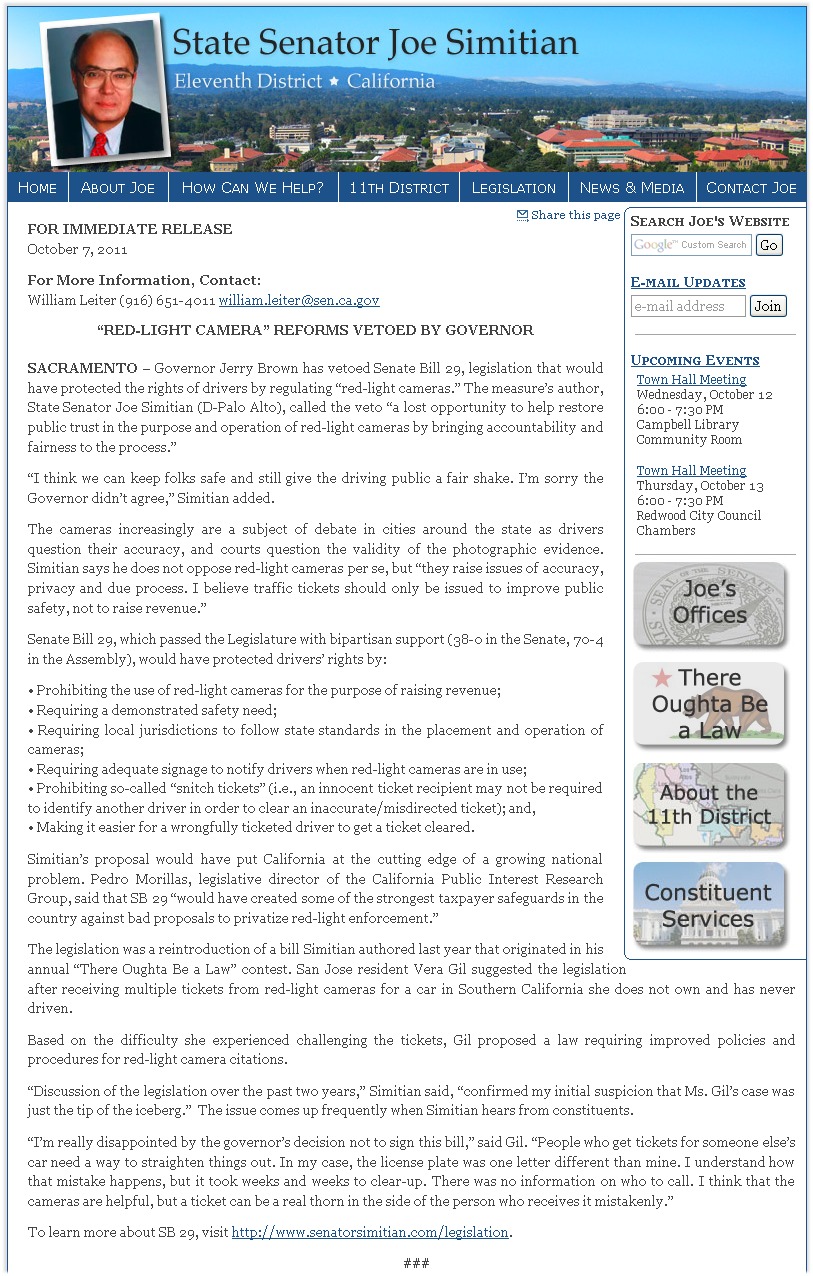
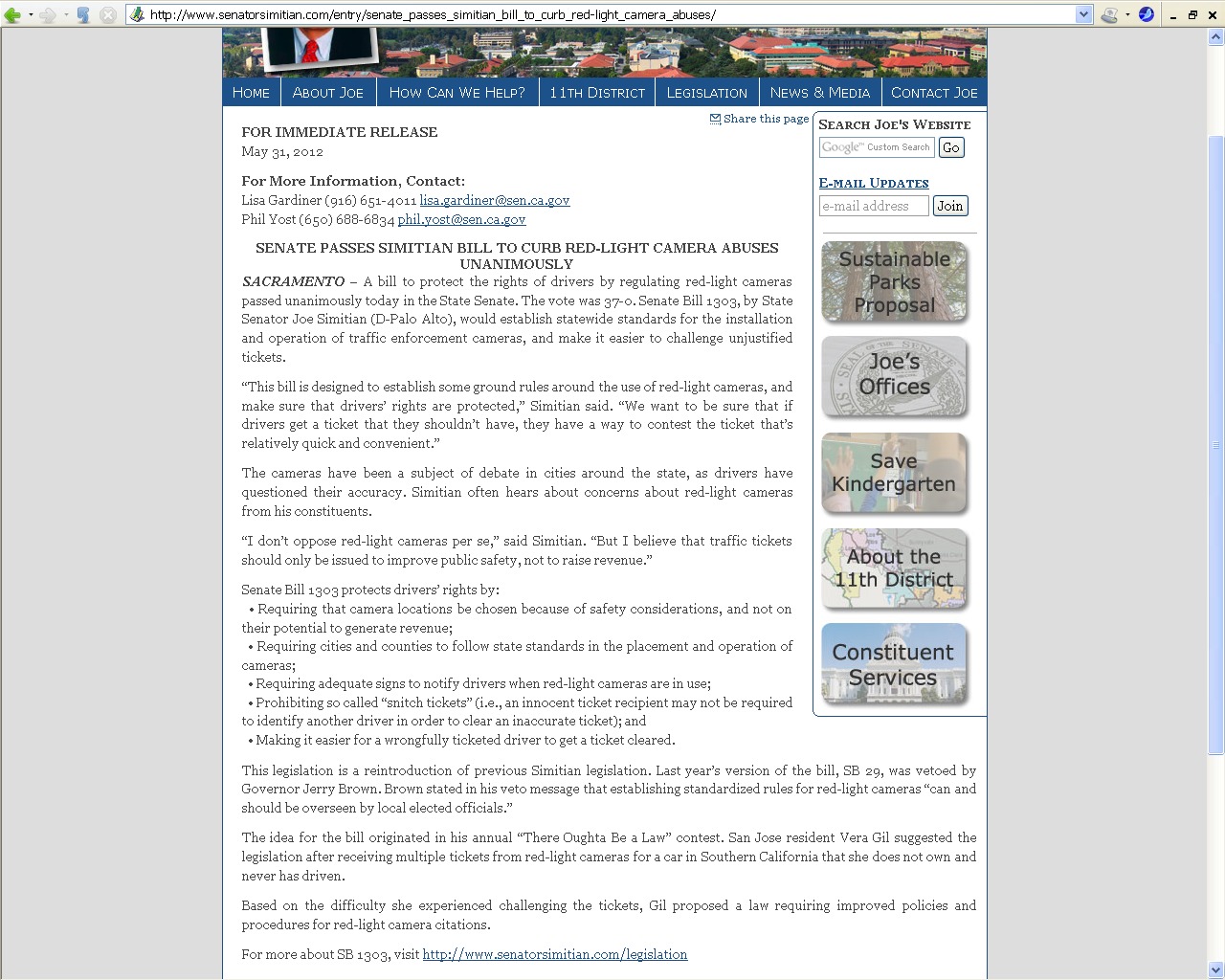
SB 1303 (Simitian), which was signed by Gov. Brown on Sept. 28, was
advertised as red light camera reform but actually will make things much worse for motorists, and much better for the Industry - and scofflaws. It is a Trojan Horse bill: It was presented as a gift to California motorists but actually lets the enemy (the Industry) storm the castle.
A May 29 amendment to the bill - prompted by the fact that earlier in May two red light camera cases reached
the California Supreme Court - will block a defendant's hearsay objections.
|
"(e) The printed representation of computer-generated information,
video, or photographic images stored by an automated traffic
enforcement system does not constitute an out-of-court hearsay
statement by a declarant under Division 10 (commencing with Section
1200) of the Evidence Code."
|
Sen. Simitian's willingness to add this last minute "hearsay is OK" amendment to his bill will save RedFlex a lot of money - they won't have to pay lawyers to fight the two cases at the Supreme Court.
An Apr. 12, 2012 RedFlex memo revealed that RedFlex wrote the amendment and provided it to the Senator - at his request.
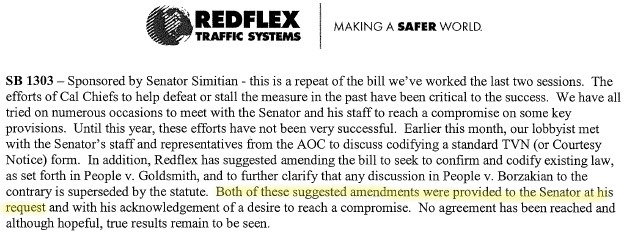
In this memo, "Cal Chiefs" is the Cal. Assn. of Chiefs of Police, "AOC" is the Administrative Office of the Courts, and "TVN" is Traffic Violation Notice, one of the Industry terms for what the public calls a Snitch Ticket
"To my friends everything, to my enemies the law."
("Para mis amigos, todo, para mis enemigos, la ley.")
Attributed to Marshal Oscar R. Benavides Larrea, Peruvian President, 1876 - 1945, and Getulio Vargas, Brazilian President, 1882 - 1954
As was made clear by the nature and source of the hearsay amendment, SB 1303 is an "Industry" bill. Even before the "hearsay is OK" amendment Simitian had filled the bill with changes favoring the Industry. It will reduce the number of warning signs, which will provide less warning to motorists, thus more intersection incursions. The bill's change to the location of warning signs will help scofflaws run red lights (explained in the box below). The bill legitimizes Snitch Tickets. The bill may allow a delay, beyond the present 15-day deadline, of the mailing of a real ticket (a Notice to Appear). The bill appears to contain a number of protections for motorists, but in reality the protections - heavily touted by Simitian - are toothless and ineffective (see why, below), "sheep's clothing" added to the bill to disguise its pro-Industry nature.
On Sept. 28 Governor Brown signed SB 1303. If you have a comment for him, he is at (916) 445-2841. Or you can email him, via the Contact form on his website www.gov.ca.gov.
SB 1303 in Detail
SB 1303: The Cast of Characters
SB 1362 of 2010, the first version of the bill (killed in the Appropriations Committee)
SB 29, the 2011 version of the bill (vetoed by Gov. Brown)
SB 1303 of 2012 (signed 9-28-12)
SB 1303: Warning Sign Requirement Helps Scofflaws
SB 1303 started in 2010 as Simitian's SB 1362, which - before a May 2010 amendment - actually would have increased the number of warning signs. As shown below, it required signs in all four directions at the intersections and at the entrances to town.
|
"
[Emphasis added.] |
2010's SB 1362 failed to pass, even after the removal of the passage which would have required more warning signs. So, going into 2012, California law remained as enacted in 1995 by SB 833: A city shall post the entrances to town or all four directions ("approaches") at photo enforced intersections.
2012's SB 1303 removes the option to post the entrances to town, and requires signs only at intersections and only on the one or two approaches (of the four) actually having a camera; many cities will have fewer warning signs than currently. In some towns which have just two cameras (examples: Belmont, Grand Terrace, Highland, Lynwood) there will be just two signs, while under present law those towns are likely to have substantially more than two signs if they have chosen to post the entrances to town, or eight signs if they have chosen to post the intersections.
|
Unforeseen Consequence - SB 1303 Helps Scofflaws When a city has posted only the entrances to town - an option that SB 1303 takes away - drivers who are new to town are left uncertain about where the cameras actually are. If you think about it, that uncertainty is actually a good thing. How so? Now that SB 1303 has changed the law to require a warning sign near each camera, drivers new to town will no longer have to guess where the cameras are, and the scofflaws among them will know for certain that if there isn't a big warning sign right in front of them, there's no camera at that intersection and they can blast through without risking a ticket.  We will be telling scofflaws exactly where red light cameras are - and are not - so why not require cities to post this sign too? (Click on picture to enlarge) The Industry has been claiming that there is a Halo Effect - that the presence of cameras at just a few intersections leads to better behavior all over town. If the Halo Effect does exist, SB 1303 will put an end to it. |
SB 1303: Snitch Tickets
|
"Prohibits Snitch Tickets" - Not Ever !
That claim was in his press releases on the 2011 bill, Simitian has been making - and repeating - this claim despite the fact that his bills have never contained such a ban.
His current bill actually legitimizes the fake tickets, which - here - he called a "notice of nonliability." (Later on, he gave them an additional name, "Courtesy Notice.")
Sen. Simitian: Lying, or Losing It?
In the photo above, he is showing the KTVU
reporter a document, which in the close-up (below) appears to be the Oct. 7 press release.
The article was reprinted in at least four other newspapers. On Aug. 30 we asked the Mercury to print a correction. They - including their publisher - refused to do so. Sen. Simitian did finally change SB 1303 to aid motorists... maybe. On Aug. 6, 2012 he amended the bill to formalize the format of a Snitch Ticket and to require a heading saying, "Courtesy Notice: This is Not a Ticket." The new heading may turn out to be a "mixed blessing." See "Sowing Confusion," below. |

SB 1303: Sowing Confusion - Now a Snitch Ticket is to be a "Courtesy Notice"
Those of us who have received a traffic ticket or two have learned that a Courtesy Notice
is the reminder/bail notice that the court
mails to us a week or two after a real ticket has been filed with them.

Heading, Courtesy Notice Sent Out by San Diego
Superior Court
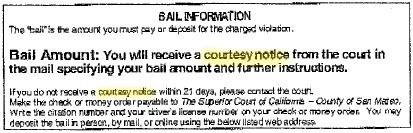
Real ticket from City of San Mateo, mentions Courtesy Notice
In the past, when we heard Sen. Simitian mistakenly call a Snitch Ticket a "Courtesy Notice" (in the 2011 KTVU interview above, and elsewhere), we assumed that the Senator's misuse of the title was innocent error by a man who may never have had to deal with a traffic ticket. But, on Aug. 6, 2012 Simitian formalized the mistake. Now the bill
requires that "COURTESY NOTICE: THIS IS NOT A TICKET" be printed top center on the front and back page of each Snitch Ticket.
Simitian added the Courtesy Notice heading after heavy Industry opposition forced him to remove, from that back page, a check box saying "None of the above."
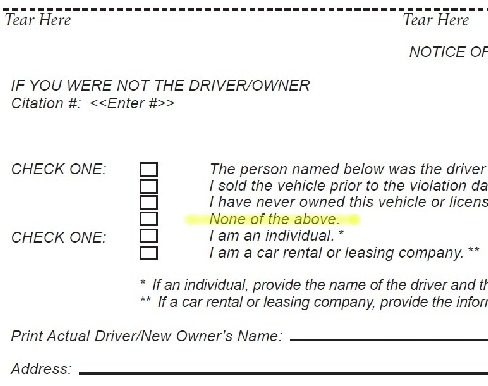
Form specified by SB 1303 of 2012, prior to Aug. 6 amendment.
SB 1303: Sowing Confusion - The Mailing Deadline
The same section that legitimizes Snitch Tickets also clouds the present 15-day deadline for the mailing of a real ticket.
[Emphasis added.]
A careful reading of the passage above suggests that if the police mail a "notice of nonliability" (which the Senator now is calling a Courtesy Notice and which the public calls a Snitch Ticket)
to someone, they can wait a full year - the Statute of Limitations - to mail out a real ticket (a Notice to Appear), which can go to an entirely different person - who will be unable to defend himself.
SB 1303: The Timing
The timing of the "hearsay is OK" amendment is significant. Simitian first added that section on Tuesday, May 29, just three days before the deadline for bills to clear the Senate. That was also just seven days before June 5 when he was up for election for Santa Clara county supervisor. (He is termed out of the Senate.) Simitian must have reasoned that local voters would not find out about the big favor he did for RedFlex until well after election day.
SB 1303: The "Protections" are Sheep's Clothing
Beware of false prophets, which come to you in sheep's clothing, but inwardly they are ravening wolves.
(Gospel of Matthew 7:15, King James Bible)
The numerous "protections" this bill promises to motorists are there to hide the real bite in the bill - the many things helping the Industry. The "protections" also were designed to lull Simitian's constituents into thinking that the Senator is helping them, so that they would vote for him for supervisor. In reality, the "protections" are toothless and won't help motorists because in a June 2010 amendment the Senator removed the consequences that were to apply to cities and/or camera companies ignoring the protections.
|
"
(3) Any citation issued by a law enforcement agency shall be dismissed if the court finds that the governmental agency has failed to operate the automated traffic enforcement system in compliance with the requirements of this section or any other law applicable to automated traffic enforcement. (4) If a court finds that the governmental agency has failed to operate the system in compliance with this section or any other law applicable to automated traffic enforcement, a law enforcement agency shall not issue any citations until the governmental agency demonstrates to the satisfaction of the court that it is in full compliance with the requirements of this section or any other law applicable to automated traffic enforcement. |
In a recent Appellate Division decision in Napa, the judge summed it up pretty well:
"A statute violation does not render evidence inadmissible unless the statute so provides...."
Anything else is just pretend.
|
For the Future: How to Recognize a Genuine "Reform" Bill A real reform bill will have teeth. If it requires (or bans) certain actions by a city, it will specify what is to happen if the city ignores the requirement (or ban). California's Speed Trap Law is an example. CVC 40803. (a) No evidence as to the speed of a vehicle upon a highway shall be admitted in any court upon the trial of any person in any prosecution under this code upon a charge involving the speed of a vehicle when the evidence is based upon or obtained from or by the maintenance or use of a speed trap. CVC 40804. (a) In any prosecution under this code upon a charge involving the speed of a vehicle, an officer or other person shall be incompetent as a witness if the testimony is based upon or obtained from or by the maintenance or use of a speed trap. |
SB 1303: Is It Constitutional?
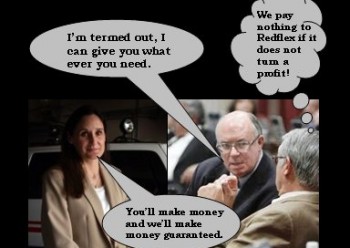
Imagined meeting of Simitian, (former) RedFlex President Karen Finley, and typical city representative
In a June 2
article, the Palo Alto Free Press questioned the constitutionality of the May 29 "hearsay is OK" amendment.
The article was the source of the illustration above.
SB 1303: In Summary...
If Simitian's heart was in the right place, to be fair to motorists while maximizing safety, he would have let the Supreme Court decide what is hearsay and what isn't, he would not have tampered with the (17-year-old) warning sign requirement, and he would have reduced the fine for rolling right turns. Instead, SB 1303 interferes with the Court, tampers with the sign requirement and will do nothing about the fine, so we have to assume the worst of motives on the part of the Senator.
If these things are not enough confirmation about Simitian's motives, consider his voting record.
SB 1773 of 2006 (added 20% to all fines statewide): Yes
AB 117 of 2008 (would have added $20 to all fines in Santa Clara
County): Yes
SB 1325 of 2008 (would have allowed speed cameras): Yes
SB 570 of 2009 (would have gutted the protection the Speed Trap Law
provides to motorists): Yes
ABX 8-3 of 2010 (effective June 2010, added 20% to all fines statewide - an additional $20 on a camera ticket): Yes
AB 909 of 2010 (if signed by the governor [he vetoed it], would have reduced the fine for rolling rights): No
AB 529 of 2011 (lowered speed limits, thus permitting shorter yellows): Yes
SB 1303 was signed by Governor Brown. If you have a comment for him, he is at (916) 445-2841. Or you can email him, via the Contact form on
his website www.gov.ca.gov.
CalPIRG Supported the Bill! Why?
Simitian's Sept. 28 (post-signing) press release revealed that CalPIRG was a supporter of the bill.
More contact info, for your legislators and your auto club, plus other info about how the legislative process works, is available in the big purple box, above.
2012 Legislation, # 2 of 8
2012: AB 2128 - Red Light Camera Reform (Support) (Failed)
Updated 5-26-12
AB 2128 (Cook) would have
lowered the fine for rolling right turns and lengthened yellow lights by one second.
On April 9 this bill was approved, unanimously, by the Assembly Transportation Committee. Then it was sent to the Assembly Appropriations Committee which, on May 2, put it in their "suspense" file. The bill died when the Appropriations Committee failed to take action on it by May 25.
The California AAA clubs took a neutral position on this bill. Please urge them to stand up for motorists. Phone numbers and info about the legislative process, are available in the big purple box, above.
The longer yellows would have reduced collisions by about 40%.
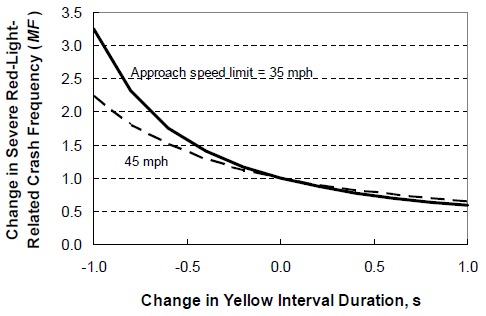
Source: "Development of
Guidelines for Treating
Red-Light Running,"
Texas
Transportation Institute, pg 2-20.
California's minimum yellows are significantly shorter than those in Oregon.
| Posted Speed* |
Min. Yellow Oregon |
Min. Yellow California |
| 25 (and left turns) |
3.5 |
3.0 |
| 30 |
3.5 |
3.2 |
| 35 |
4.0 |
3.6 |
| 40 |
4.3 |
3.9 |
| 45 |
4.7 |
4.3 |
( *Update: Beginning 8-1-2015 California cities are required to use the 85th Percentile speed, rounded up, instead of the posted speed, to set the minimum yellow at a photo enforced intersection. See Defect # 2 for more information about that change.)
AB 2128's proposed longer yellows were an attempt to respond to the shorter yellows that resulted from AB 529 of 2011 (discussed below).
AB 2128's lower fine for rolling rights was a repeat of AB 909 of 2010 (discussed below).
In Jan. 2018 another bill to lower the fine was filed - SB 1132
2012 Legislation, # 3 of 8
2012: AB 2192 - Reforming "Protected Plates" (Support) (Failed)
Updated 6-15-12
AB 2192 (Miller) was Miller's third attempt to require the holders of 1.5 million "protected plates" to give
the DMV a service address for the mailing of toll and red light camera violations.
On April 23 this bill was approved, unanimously, by the Assembly Transportation Committee. Then it was sent to the Assembly Appropriations Committee which, on May 9, put it in their "suspense" file. The bill died when the Appropriations Committee failed to take action on it by May 25.
The California AAA clubs took a neutral position on this bill. Please urge them to stand up for motorists. Phone numbers and info about the legislative process, are available in the big purple box, above.
"When a few leaders are so able to insulate themselves from everybody else... that has a corrosive effect."
Capt. Chesley Sullenberger on Tavis Smiley show, 6-15-12.
The state will get a lot of additional income if the holders of protected plates are required to pay their tickets, so why did Appropriations kill this bill? In the past (2010 and 2011) the
opponents have pointed out that it will cost $1 million or more for the DMV to collect the addresses, while failing to mention the additional income from fines. This ruse is understandable, as they are protecting a privilege that saves themselves and their families hundreds of dollars per year.
(For more info about protected plates, see AB 2097 in the 2010 Legislation section, further down this page, and FAQ # 22.)
If all these bill numbers are beginning to circle around in your head, I suggest that you go to the Site Index and print out the 'Cheat Sheet' available there. That way, you will have a ready reference to refresh your memory. I use it too!
2012 Legislation, # 4 of 8
2012: Bill # ??? - Speed Cameras (Oppose) (Bill Failed in 2011 - Watch Out in 2019)
Updated 5-15-12
Proposals to legalize the use of speed cameras in California have been before the legislature in six of the last seven annual sessions. 2011's speed camera bill AB 1311 (Miller) failed to make it out of the Assembly by the deadline, so it died. But a new speed camera bill could be launched any time during the 2012 session.
To help get photo radar's foot in the door, the 2011
bill (AB 1311)
restricted the use of the cameras to school zones.
Details about the 2010 and earlier speed camera bills are available in the Previous Legislation sections, below.
2012 Legislation, # 5 of 8
2012: Assembly Bill 2147 - Bench Warrants for MTA/Metro Camera Tickets (Failed)
Updated 5-15-12
AB 2147 (Cedillo) dealt with tickets issued by the Los Angeles County MTA, or "Metro," at 47 red light cameras it has installed along its busways and light rail lines. Buried just below the middle of the bill's 1500 words is this:
AB 2147 failed to make it out of the Transportation Committe by the May 11 deadline, so it is dead - unless it can get a 2/3 vote to waive the deadline. Such waivers are rare, but we will continue to watch this bill.
2012 Legislation, # 6 of 8
2012: Assembly Bill 539 - $565 Fine for Speeding in School Zone (Subject Changed to Toll Info) (Watch)
Updated 6-16-12
AB 539 (Williams), was introduced in Feb. 2011 to raise the fine for speeding in a school zone from $465, to $565, plus the cost of traffic school. In June 2011 it was held up in a Senate committee, but came back alive in June 2012, amended to deal with the sharing and selling of license plate data obtained by toll road operations. The bill could change subject area again, so we will continue to watch it.
2012 Legislation, # 7 of 8
2012: Assembly Bill 432 - Tickets Must Be Mailed in Official Envelope (Subject Changed to Transit Funding) (Watch)
Updated 6-27-12
AB 432 (Hall), introduced in Feb. 2011, was a "spot bill*," or a "place holder," as its most significant requirement was for red light camera tickets to be mailed in an official envelope. In June 2011 the author chose to put it on hold, but brought it back to life in June 2012, amended to deal with transit funding. The bill could change subject area again, so we will continue to watch it.
*Spot bill: A bill that proposes nonsubstantive amendments
to a code section; introduced to assure that
a bill will be available after the deadline to introduce bills,
for revision to cover any subject matter.
2012 Legislation, # 8 of 8
2012: Senate Bill 1071 - Minor Changes to CVC 21455.5 (Spot Bill) (Failed - Watch)
Updated 6-12-12
SB 1071 (Harman), is a "spot bill*," or a "place holder." The Legislative Analyst described SB 1071 as making "...technical, nonsubstantive changes...." SB 1071 failed to make it out of the Senate by the June 1 deadline, so it is dead - unless it can get a 2/3 vote to waive the deadline. Such waivers are rare, but we will continue to watch this bill.
Previous Legislation - 2011 & 2010
Legislation from 2009 and before is discussed in Section 6, further down this page.
2011 Legislation
2011 Legislation, # 1 of 8
2011: AB 529 - Lowered Posted Speed Limits, Shortened Yellow Lights (Opposed) (Signed 10-7-11)

Updated 10-9-11
AB 529 (Gatto),
allowed cities to reduce many posted speed limits by 5 mph. Those lower speed limits allowed the cities to shorten their yellows lights by 0.3 to 0.4 second, if they wished. (Later
counteracted to some extent by CTCDC action in late 2014. See Defect # 2.) Shortening a yellow light by 0.35 second raises the rate of severe accidents by about 30%. Gov. Brown signed AB 529 on Oct. 7, 2011, and it went into effect on Jan. 1, 2012.
Source: "Development of
Guidelines for Treating
Red-Light Running,"
Texas
Transportation Institute, pg 2-20.
Even without AB 529, California's minimum yellows were already significantly shorter than those in Oregon.
| Posted Speed |
Min. Yellow Oregon |
Min. Yellow California |
| 25 (and left turns) |
3.5 |
3.0 |
| 30 |
3.5 |
3.2 |
| 35 |
4.0 |
3.6 |
| 40 |
4.3 |
3.9 |
| 45 |
4.7 |
4.3 |
Why then, if California's yellows were already shorter than in a neighboring state, and shorter yellows were known to make intersections more dangerous, did our Legislature make them even shorter? It could be money. Four of the sponsoring cities have red light cameras, and shorter yellows produce a lot more red light camera tickets.
The lower speed limits also made it easier for California cities to issue speeding tickets.
|
AB 529 - In Detail
AB 529 changed how speed surveys determine the speed limit that is to be posted on a street. Every seven to ten years the city traffic engineer goes out to the street and uses a radar gun to measure the speed of 100 cars. Then he discards the 15 fastest cars. The speed of the fastest car remaining is the "85th percentile speed." (AB 529 does not change this part of the survey process.) Under pre-AB 529 law, the engineer then rounded the 85th percentile speed to the nearest 5 mph increment, which could be up or down. That 5 mph increment became the posted speed limit, unless the engineer was able to cite a dangerous road condition that would not be visible to a driver (Cal. Vehicle Code Sec. 627 uses the phrase "conditions not readily apparent to the driver"), such as a higher-than-average accident rate or a hidden driveway. If the street was a dangerous one, the engineer could lower the posted limit to the next-lower 5 mph increment. Thus, an 85th of 33, normally posted as 35, could have been lowered to 30 - but only if there was a hidden danger or a high accident rate. Under AB 529, the engineer still is required to round to the nearest 5 mph increment. But then, if the rounding moved the number up, he is allowed to subtract 5 mph, even if the street is a safe one; he does not need to cite a dangerous condition as justification. Thus, the speed limit on a street having an 85th of 33 can result in a posted speed of 30 – even if there's a very low incidence of accidents and no hidden dangers. Here is the text of the law, which went into effect on 1-1-2012. "21400 (b) The Department of Transportation shall revise the California Manual on Uniform Traffic Control Devices [MUTCD], as it read on January 1, 2012, to require the Department of Transportation or a local authority to round speed limits to the nearest five miles per hour of the 85th percentile of the free-flowing traffic. However, in cases in which the speed limit needs to be rounded up to the nearest five miles per hour increment of the 85th-percentile speed, the Department of Transportation or a local authority may decide to instead round down the speed limit to the lower five miles per hour increment, but then the Department of Transportation or a local authority shall not reduce the speed limit any further for any reason." MUTCD, as Modified by AB 549
and reduce the speed to 35. Now that this bill has been enacted into law, I suggest that a new lower speed limit instituted on what was a safe street (in bold above) should be called a Gatto Trap, and that a new shorter yellow on that street should be called a Gatto Yellow. What Honest Engineers Think In its publication "Realistic Speed Zoning" the AAA warned about: "...widely held misconceptions, such as: • Speed limit signs will slow the speed of traffic. • Speed limit signs will decrease the accident rate and increase safety. • Raising a posted speed limit will cause an increase in the speed of traffic." --- In a June 22, 2011 interview the Public Works Director of a California city which once had red light cameras explained - very well - why the arbitrary lowering of speed limits does not work: "The speed limit is what you, the motoring public, based on your behaviors, have determined is appropriate. It’s not the speed limit sign that controls the speed of traffic. It’s the speed of traffic that controls what the posted speed limit sign is going to say." "Studies have shown that accidents are lower when drivers are driving in a uniform manner at about the same speed. When there’s a larger differential in speed where some people are driving slow and some people are driving fast, that can cause some drivers to make sudden lane changes because faster drivers want to get around the slow-driving person." "If a public agency chooses to (decrease) a segment of roadway, that can cause friction in the flow of traffic because the majority of traffic will continue to drive what they feel is a prudent speed." "But we may get a few overly conservative drivers that force themselves to comply with the sign, and that will cause them to drive significantly slower than the rest of traffic, which can cause accidents." --- On June 14 a traffic engineer wrote the following to the Senate Transportation and Housing Committee: "Please note that the City of Fountain Valley's chart below addresses the common myth that drivers increase their speed if limits go up. This simply is not true as the below chart illustrates..." 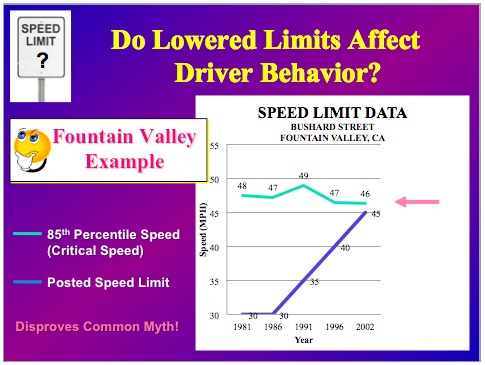 Click on the image, for larger size. "I urge this committee, in the interest of safety and just fairness to the public, to respect the work that was done over many years between the State, local agencies, traffic engineers and the CHP & to not subvert engineering practice and safety through this legislation." What Some Engineers Do Set # 1 on the Fremont Docs page includes a 2015 - 2016 instance where the city's engineers, to keep posted speeds (and yellow light lengths) from rising, re-ran surveys that had been conducted six months before and lowered all twelve of the 85ths, by an average of 5.6 mph. --- For much more info about speed surveying, read the informal discussion on this site. |
|||||||||||||||||||||||||||||||||||||||
2011 Legislation, # 2 of 8
2011: Senate Bill 29 - Reduces Number
of Warning Signs (Oppose)
(Vetoed 10-7-11)
(Attempt to Override Veto Failed)
3-25-12
Simitian's SB 29 (discussed below) was vetoed by Gov. Brown on Oct. 7, but there was still the possibility that the legislature
could vote to overturn the veto. The deadline to take that vote, March 1, 2012, passed without a vote, so the veto was "sustained." When
you call your
legislators to let them know how you feel about AB 529's shorter yellows (above), the legislature's failure to reduce the fine for
rolling rights (# 3 of 8, below), and their failure to do anything about the 1.5 million protected plates (# 6 of 8, below), please
also thank them for putting an end to SB 29.
SB 29 (Simitian,
with Huff and Anderson) was sold as red light camera reform, but actually would have made things worse for
motorists. Among other things, it would have reduced the number of warning signs, from four per intersection to one or two. (See the bill's version of 21455.5(a)(1).) Fewer signs would have meant (a), less warning to motorists, thus more tickets issued and (b), a reduction in safety, discussed in the box, below. SB 29 also would have legitimized Snitch Tickets, and may have allowed a delay, beyond 15 days, of the mailing of a Notice to Appear. (See the bill's version of 40518(c).) The rest of the bill's 1855 words did little more than "rearrange the furniture." Perhaps the purpose of the extra verbiage was to hide the portions of the bill that would have reduced warning signs and extended the mailing period for tickets. "Prohibits Snitch Tickets" - Not !
...despite the fact that the bill never contained such a ban. Sen. Simitian: Lying, or Losing It? In the photo above, he is showing the KTVU
reporter a document, which in the close-up (below) appears to be the
Oct. 7 press release.
SB 29 originated as SB 1362 of 2010, which failed when on Aug. 13, 2010 the Assembly Committee on Appropriations killed it. (See detailed
info about SB 1362, and the senators, in the 2010 Legislation section, further down this page.) The original
version of the 2010 bill actually increased the number of warning signs. Had the original version of SB 1362 passed, signs would have had
to be posted in all four directions at the intersections and at the entrances to town. (Present law gives
the city the option to post the intersections or the entrances.)
The Consequences of Fewer Signs
Under SB 29's (proposed) new language, there will be fewer warning signs. Cities will no longer be required to post signs at the entrances to town or on all four sides ("approaches") of the intersections having photo enforcement. Signage will be required only at the photo enforced intersections, and only on the one or two approaches (of the four) actually having a camera.
The Effect on Intentional Running
With few signs, a scofflaw inclined to run the red lights in town will no longer be unsure about which intersections he can run through. After reading SB 29 he will know that if there isn't a big warning sign right in front of him, he can blast through without risking a ticket.
The Industry has been claiming that there is a Halo Effect - that the presence of cameras at just a few of the intersections in town leads to
better behavior all over town. If the Halo Effect does exist, SB 29 will put an end to it.
As had happened to the 2010 bill, SB 29 was stalled (on "suspense") in the Assembly Appropriations Committee until Aug. 26, 2011 when a dirty deal was made - SB 29 was allowed to move ahead, in exchange for the striking-out (removal) of a section which would have required cities to modify their Snitch Ticket (fake ticket) forms to make it clear that no response is required.
If the issuing agency or the manufacturer or supplier of the automated traffic enforcement system contacts the registered owner of a vehicle prior to issuing a notice to appear in an effort to determine the identity of the driver, the registered owner shall be made aware, in a clear and prominent fashion, that the registered owner is not required to provide the information and that failure to provide the information will not result in additional responsibility or liability associated with the alleged violation.
Sen. Simitian's interviews and press releases claimed that SB 29 would prohibit Snitch Tickets...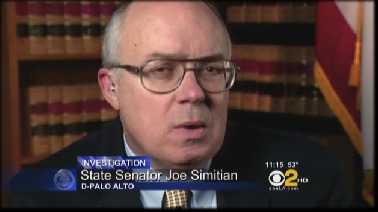
"My bill specifically prohibits so-called Snitch Tickets."
Sen. Simitian interviewed on KCBS-2 (Los Angeles) Feb. 13, 2011
From Oct. 7, 2011 press release
The bill actually would have legitimized the fake tickets:
"That's not a lie, it's a terminological inexactitude. Also, a tactical misrepresentation."
(Ret. Gen.) Alexander Haig, Nixon's Chief of Staff, Secretary of State to Reagan, 1924 - 2010
SB 29 was one of the Senator's most prominent bills, so he should have remembered that on Aug. 26 he stripped-out the language
requiring that a Snitch Ticket include a "clear and prominent" notice to the registered owner. And he should have
remembered that with that stripping his bill would impose no limitation of any kind upon the issuance of Snitch
Tickets. But did he remember? On Oct. 7 he issued the erroneous press release, and then
in a KTVU-2 (San Francisco) interview
aired Nov. 3, we see him talking tough about Snitch Tickets, giving us the impression that he has done something about them.
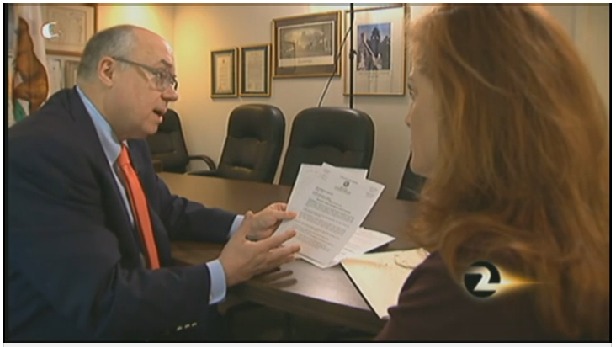
"People get a ticket in the mail, or a Courtesy Notice as it is called, and they're told, 'You have to fill this out or else you're
gonna get the ticket.' "
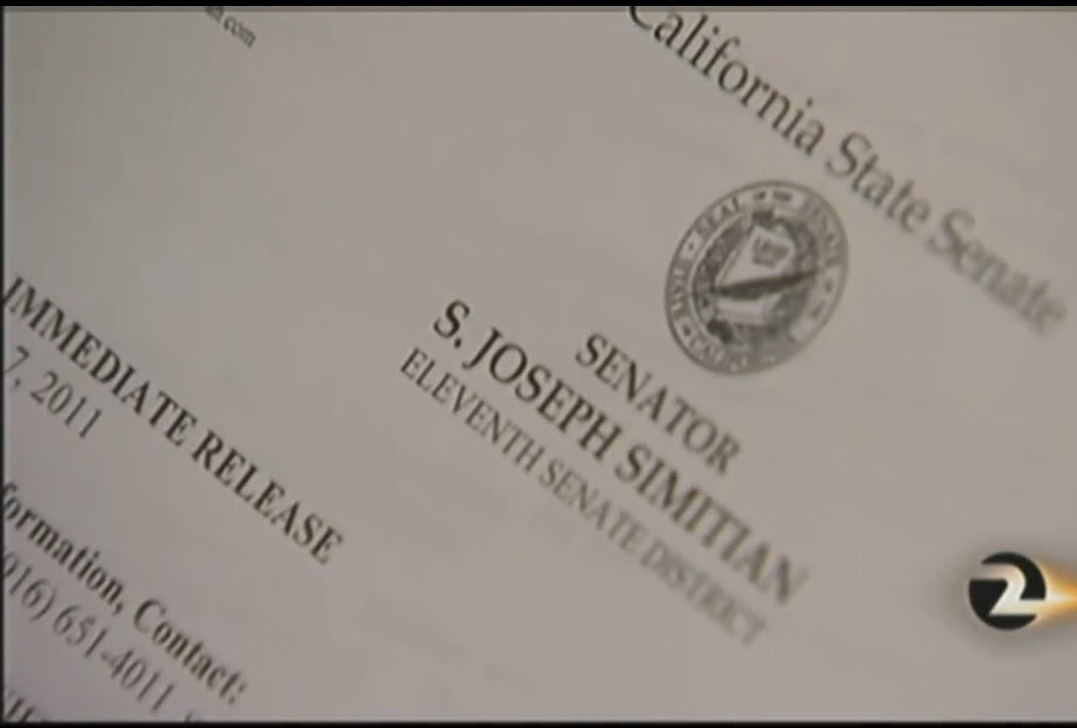
Click image to enlarge.
If the three senators' hearts had been in the right place, to be fair to motorists while maximizing safety, they would have reduced the fine for rolling right turns and they would not have tried to tamper with the (17-year-old) warning sign requirement.
They did not propose a reduced fine, and they did try to reduce the number of warning signs, so we have to assume the worst of motives on the part of the senators and their supporters.
If you see Governor Brown, thank him for vetoing this bill. And ask your Sacramento legislators to vote against any
attempt to override Brown's veto.
|
For the Future: How to Recognize a Genuine "Reform" Bill A real reform bill will have teeth. If it requires (or bans) certain actions by a city, it will specify what is to happen if the city ignores the requirement (or ban). The Speed Trap Law is an example. CVC 40803. (a) No evidence as to the speed of a vehicle upon a highway shall be admitted in any court upon the trial of any person in any prosecution under this code upon a charge involving the speed of a vehicle when the evidence is based upon or obtained from or by the maintenance or use of a speed trap. CVC 40804. (a) In any prosecution under this code upon a charge involving the speed of a vehicle, an officer or other person shall be incompetent as a witness if the testimony is based upon or obtained from or by the maintenance or use of a speed trap. Anything else is just pretend. |
2011 Legislation, # 3 of 8
2011: Bill # ??? - Reduce the Penalty for Rolling Rights (Missing - No Bill Submitted) (Push for Bill in 2012)
Updated 9-8-11
During the 2010 session there was AB 909 by Assemblyman Jerry Hill of San Mateo, which would have cut the fine almost in half. It passed thru the legislature but was vetoed by Gov. Schwarzenegger. (More info about AB 909 is in the 2010 Legislation section, further down this page.) In Dec. 2010 our legislators began submitting bills for consideration
during the 2011 session, and by Feb. 18, 2011 they had submitted over 2300 new bills, but no bill to reduce the penalty for rolling right turns.
For the 2012 Session...
Contact the staff of your assemblyperson or state senator and ask them to do a bill to reduce the rolling right penalty. I think that a fine of $25 (total, including all surcharges) would accomplish the safety goal of reminding drivers not to roll around corners. Fall 2011 is the best time to make these calls. Phone numbers and info about the legislative process are available in the big purple box, above.
(Late note: In 2012 there was another bill to lower the fine for a rolling right - AB 2128. And, in Jan. 2016 another bill to lower the fine was filed -
SB 681.)
If all these bill numbers are beginning to circle around in your head, I suggest that you go to the Site Index and print out the 'Cheat Sheet' available there. That way, you will have a ready reference to refresh your memory. I use it too!
2011 Legislation, # 4 of 8
2011: Assembly Bill 539 - $565 Fine for Speeding in School Zone (Oppose) (Bill Failed - Watch in 2012)
Updated 9-8-11
AB 539 (Williams), introduced on Feb. 17, 2011, would have raised the fine for speeding in a school zone from $465, to $565, plus the cost of traffic school.
This bill was held up in the Senate Transportation and Housing Committee. But it could come back alive, next year, so continued opposition is necessary.
2011 Legislation, # 5 of 8
2011: Assembly Bill 432 - Minor Changes to CVC 21455.5 (Spot Bill)
Updated 9-8-11
AB 432 (Hall), introduced on Feb. 14, 2011, was a "spot bill*," or a "place holder." The Legislative Analyst described AB 432 as making "...technical, nonsubstantive changes...." While it didn't seem to do much, it was fully "alive" - it had been approved by the Assembly and, until Sept. 2 could have been amended in the Senate to become an important bill. Thus, it had to be watched, carefully.
We encouraged the assemblyman to amend this bill to reduce the fine for rolling right turns, but he did not.
*Spot bill: A bill that proposes nonsubstantive amendments
to a code section; introduced to assure that
a bill will be available after the deadline to introduce bills,
for revision to cover any subject matter.
2011 Legislation, # 6 of 8
2011: Assembly Bill 3 - Dealing with "Protected Plates" (Oppose as Amended) (Bill Failed - Push for New Bill in 2012)
Updated 9-8-11
Now it is dead, but when it was originally filed AB 3 (Miller) was a good bill, a repeat of Miller's 2010 bill, AB 2097, which would have required the holders of 1.5 million "protected plates" to give the DMV a service address, for the mailing of toll and red light camera violations.
Highwayrobbery.net urged strong support for AB 2097 and for the original version of AB 3. Unfortunately, on Apr. 5, 2011, AB 3 was amended, removing the requirement to provide a service address. And then on Apr. 14 it was amended to deal only with toll road tickets; all mention of red light camera tickets was removed. Finally, it failed to make it out of the Assembly by the deadline, so it died, and cannot be revived this year. But it could be brought back in 2012, as a "Two Year Bill." So, we will watch it.
For the 2012 Session...
Contact the staff of your assemblyperson or state senator and ask them to do a new bill to deal with protected plates. Fall 2011 is the best time to make these calls. Phone numbers and info about the legislative process are available in the big purple box, above.
(For more info about protected plates, see AB 2097 in the 2010 Legislation section, further down this page, and FAQ # 22.)
Highwayrobbery.net provided the info in the box below during the time when the bill dealt with red light camera tickets.
|
Until the recent amendments AB 3 was a repeat of a good bill, Miller's AB 2097 of 2010, which required the holders of 1.5 million "protected plates" to provide a service address to the DMV so that those motorists can be sent their toll and red light camera violations. In 2010 AB 2097 passed through four votes, all unanimously (in three committees and on the Assembly floor), but then was killed by the Senate Committee on Appropriations (on Aug. 13). |
2011 Legislation, # 7 of 8
2011: AB 1311 - Speed Cameras (Bill Failed - Watch in 2012)
Updated 9-8-11
(This bill failed to make it out of the Assembly by the deadline, so is dead, for now. But it could be brought back as a "Two Year Bill," during the 2012 session. So, we will watch it.)
AB 1311 (Miller), would have legalized the use of speed cameras in California.
To help get photo enforcement's foot in the door, the bill restricted the use of the cameras to school zones.
Speed camera proposals have been before the legislature in six of the last seven annual sessions - see details about those bills, below.
2011 Legislation, # 8 of 8
2011: Assembly Bill 1008 - Ban the Cameras (Oppose) (Bill Failed - Watch in 2012)
Updated 9-8-11
(This bill failed to make it out of the Assembly by the deadline, so is dead, for now. But it could be brought back as a "Two Year Bill," during the 2012 session. So, we will watch it.)
AB 1008 (Cook), was introduced on Feb. 18, 2011, and was a "non-starter" - it failed to gain approval by the first committee to hear it. While this bill sounded good - it would have stopped the installation of any new cameras after Jan. 1, 2012 - I think that at this point, a ban on new cameras is meaningless, almost an insult to the public. The main beneficiary of this bill would have been the camera Industry - the pending ban would have sparked a Gold Rush, like the one that occurred in Dec. 2003 just
before the AB 1022 ban on pay-per-ticket contracts was to go into effect. During that month, Del Mar, Emeryville, Escondido, Lynwood, Maywood, Oceanside, Ridgecrest, Santa Clarita, Santa Fe Springs, Solana Beach and Vista signed new contracts. And the City of Upland signed a ten-year extension to the contract it first signed five months before.
Let us encourage Mr. Cook to amend this bill in 2012, or do a new bill, to reduce the fine for rolling right turns. Phone
numbers and info about the legislative process are available in the big purple box, above.
Previous Legislation: 2010
Legislation from 2009 and before is discussed in Section 6, further down this page.
2010 Legislation, # 1 of 8
2010: Gov. Schwarzenegger's
Budget Includes Speed Cameras! (Oppose) (Left Out of Final Budget)
Info about the speed camera bills proposed before 2010 is in Section 6, further down this page.
Highwayrobbery.net provided the info in the box below during the time when the budget, including possible speed cameras, was not yet final.
At page LJE 9 of the budget details, it says, The blog laist.com commented: "The SacBee duly noted that 'the governor did not propose increasing fines for talking on cell phones while driving or parking in red zones,' both of which his wife was caught on camera doing last year." Another article. And another. |
2010 Legislation, # 2 of 8
2010: New $40 Surcharge - (Oppose) (Left Out of Final Budget)
For info about bills proposed before 2010, scroll way down, or click: Legislation 1994 - 2009
Some newspaper articles,
and a May 2010 press release from an assemblymember (see third bulleted point), revealed a proposed $40 surcharge on each ticket, which "will be debated as part of the budget during the month of June."
2010 Legislation, # 3 of 8
2010: California Assembly Bill 909 - Reducing the Fine for Rolling Right Turns (Oppose in Final Form) (Vetoed)
For info about bills proposed before 2010, scroll way down, or click: Legislation 1994 - 2009
Updated 10-10-10
Governor Schwarzenegger vetoed AB 909 on Sept. 29. His veto message:
To the Members of the California State Assembly:
I am returning Assembly Bill 909 without my signature.
A driver running a red-light, whether they are traveling straight, or turning right,
makes a very dangerous traffic movement that endangers the nearby motoring public,
bicyclists, and pedestrians. Modifying existing law to make red-light violations from a
right turn less egregious sends the wrong message to the public that California is
tolerant of these types of offenses. It is our responsibility to protect the motoring
public and not increase the risk of traffic collisions.
Therefore, I am unable to sign this bill.
Sincerely,
Arnold Schwarzenegger
Highwayrobbery.net provided the info in the box below during the time when the bill - now vetoed - was under active consideration.
|
AB 909 (Hill) has been advertised as cutting the fine for a rolling right turn to about half of what it is now. Unfortunately, it looks like the proposed cut will be nullified by new surcharges: There is the proposed $40 statewide surcharge - see above - and there is a new 20% surcharge (adding $20 to the cost of a red light camera ticket) which went into effect on June 10, 2010. So, if AB 909 passes as presently written, a rolling right ticket will cost about $400 when the two surcharges and the cost of traffic school are included. Prior to a June 14 amendment, the bill was interesting; it would have revised the law to allow a motorist to turn right without having to stop, so long as they did not interfere with a pedestrian's or other motorist's right-of-way. For more info about this bill, see this special page. I think that a $25 fine (total, including all surcharges) would be enough to remind motorists not to swoop around corners. That's what some cities outside California charge. (See the expanded version of Defect # 9 for info about those other cities.) |
(Late note: In Jan. 2016 another bill to lower the fine was filed - SB 681.)
2010 Legislation, # 4 of 8
2010: California Senate Bill 1362 - Minor Changes to CVC 21455.5 (Oppose in Final Form) (Bill Failed)
For info about bills proposed before 2010, scroll way down, or click: Legislation 1994 - 2009
Updated 8-14-10
SB 1362 failed when on Aug. 13 the Assembly Committee on Appropriations blocked it and kept it from reaching the Assembly floor for a vote by the annual deadline. Highwayrobbery.net provided the info in the box below during the time when the bill - now failed - was under active consideration.
|
SB 1362 (Simitian, with co-authors Ashburn & Huff) has been amended five times - most recently on Aug. 2 - and all that is left is a minor restriction on the issuance of Snitch Tickets, buried in CVC 40518(c) - (e) of the bill. The original version of the bill was weak - the bill has never dealt with the "gorilla in the room," the thousands of $500+ tickets for minor violations like rolling right turns. (For perspective, in New York City the camera ticket fine is $50.) And the numerous amendments weakened it further. Here is what has happened to some key provisions. Illegal acts by the city: The original bill made tickets "null and void" if the city violated the easy-to-follow rules set out in CVC 21455.5. Then a June 30 amendment removed that language. Snitch Tickets: The bill (see 40518(c) in the bill) allows cities to continue to issue an "other notice other than a notice to appear" (a Snitch Ticket), but requires that these notices be on an approved form (to be created). Until the June 30 amendment the bill said that if the form was "materially altered" the ticket "shall be dismissed." Now it says, "may be dismissed." Then there is the issue of the phone calls some police departments make to registered owners (see Creepy Phone Calls, on the Your Ticket page). While the bill's 40518(e) says that if a city "contacts" the registered owner, he is to be "made aware" that he is not required to provide information, how could the registered owner ever prove that the police failed to make that required disclosure if the contact was by phone? And even if he was able to prove that the police failed to make the disclosure, would be ticket be dismissed? The bill does not say. The bill's 40518(e) disclosure requirement also makes us realize that an equivalent requirement has not been applied to Snitch Tickets. The bill's 40518(c) lists three kinds of information that must appear on an "other notice" but it does not include a disclosure that there is no requirement to provide information. (If it was addressing this issue, we would expect the bill to specify things like the size of type and its position on the page.) Warning signs: The original bill required more signs - they would have to be posted at the intersections and at the entrances to town. Then a May 11 amendment removed the requirement for signs at the entrances to town, and the June 30 amendment removed the requirement for signs to face all directions of traffic - only the directions enforced by cameras need to be posted. Who can issue tickets: An early version of the bill changed CVC 40518 so that only a "peace officer" could issue a ticket, thus promising to end the practice in some cities of having tickets issued by non-sworn police services personnel. Then, the June 30 amendment reversed the change, again allowing so-called "qualified personnel" to issue tickets. Using clerks to issue the tickets is controversial, even in the Industry - see FAQ # 36. If it is amended again, SB 1362 should be changed to actually DO something to protect motorists. Here are some suggestions. Increase the warning ticket period to 90 days, and clarify that warning tickets must be issued at each camera, not just the first one in town. Reduce the fine for rolling rights to a maximum of $25 including all surcharges, and with no "point." (Compare to AB 909, above.) Provide for automatic dismissal of multiple rolling right tickets occurring at the same intersection within the same 30-day period, when the first one is paid (see FAQ # 40). Require that the yellow for a left turn be at least as long as the straight-thru yellow, and at least 4.0 seconds if the turn pocket is longer than 200 feet or if it is a double or triple left turn (see expanded version of Defect # 9 - C). Restore the provisions removed by the May 11 and June 30 amendments (as discussed above): "Null and void," "intersections and entrances," "only a peace officer." Right now it looks like the three senators are just trying to give the appearance of doing something, to mollify the constituents who are calling their offices to complain about ticket mills. If you act NOW, you may be able to affect SB 1362's direction. Contact your local legislators, and if you live in or commute through one of the three senators' districts, contact them. Their phone numbers are at these links. Ashburn [termed-out as of Nov. 2010] represent[ed] Bakersfield, Barstow, Tulare, 29 Palms, Ridgecrest, Visalia. Huff represents Yorba Linda, Chino Hills, Diamond Bar, La Habra, Sierra Madre, Walnut, Glendora. Simitian represents San Carlos, Redwood City, Menlo Park, Atherton, Palo Alto, Los Altos, Cupertino, Campbell, Santa Cruz, Capitola, Aptos, and part of San Jose. Going in, know Simitian's voting record: AB 909 of 2010 (if signed by the governor [he vetoed it], will reduce the fine for rolling rights): No ABX 8-3 of 2010 (effective June 2010, added 20% to all fines statewide - an additional $20 on a camera ticket): Yes SB 570 of 2009 (would have gutted the protection the Speed Trap Law provides to motorists): Yes SB 1325 of 2008 (would have allowed speed cameras): Yes AB 117 of 2008 (would have added $20 to all fines in Santa Clara County): Yes SB 1773 of 2006 (added 20% to all fines statewide): Yes While you are talking to your legislators about SB 1362, please also talk to them about the speed cameras proposed by the governor, the new $40 surcharge, and the other bills described below. For phone numbers, see the big purple box, above. |
If all these bill numbers are beginning to circle around in your head, I suggest that you go to the Site Index and print out the 'Cheat Sheet' available there. That way, you will have a ready reference to refresh your memory. I use it too!
2010 Legislation, # 5 of 8
2010: Assembly Bill 2097 - Dealing with "Protected Plates" (Support) (Bill Failed)
For info about bills proposed before 2010, scroll way down, or click: Legislation 1994 - 2009
Updated 8-14-10
AB 2097 passed through four votes, all unanimously (in three committees and on the Assembly floor), but then on Aug. 13 the Senate Committee on Appropriations blocked it and kept it from reaching the Senate floor for a vote by the annual deadline. Highwayrobbery.net provided the info in the box below during the time when the bill - now failed and replaced by AB 3 of 2011 - was under active consideration.
|
AB 2097 (Miller) was filed on Feb. 18, 2010. The Legislative Counsel's digest says: "This bill would require a person who requests the confidentiality of his or her home address to provide the department with a current employment address for purposes of processing the service and collection of a traffic, parking, or toll road violation." Under present law, the 1.5 million private vehicles having "protected plates" are, as reported by the Orange County Register newspaper, "protected from easy or efficient look up, thus are effectively invisible to agencies attempting to process parking, toll, and red light camera violations." Read more in FAQ # 22. The AAA supports this bill, and I strongly support it. But I would like to see one change. The bill's provisions don't go into effect until April 2012, nearly two years from now. I think it can and should be much sooner. I urge everyone to contact their legislators and the AAA about AB 2097. If this bill does not make it, the bureaucrats will keep laughing at us as we pay our $500+ fines. |
2010 Legislation, # 6 of 8
2010: Assembly Bill 2729 - Outlawing "Right on Green" (Oppose) (Vetoed)
For info about bills proposed before 2010, scroll way down, or click: Legislation 1994 - 2009
Governor Schwarzenegger vetoed this bill.
Late note: In late 2012 California Attorney General Kamala Harris
issued an Opinion allowing the use of
cameras to enforce "No Right Turn on Green" restrictions.
Highwayrobbery.net provided the info in the box below during the time when the bill - now vetoed - was under active consideration.
|
AB 2729 (Ammiano) would allow cameras to be used to enforce a "No Right Turn on Green" restriction at one intersection in San Francisco. The right turn is prohibited (even on green!) because turning cars have been hitting bicyclists using the parallel bike lane. I oppose this bill because it proposes an expansion of the use of cameras to deal with a situation where no one has presented information as to whether it is visitors, or "locals," who are causing the accidents, and I believe that the cameras would be ineffective against violations by visitors. Further, a City memo indicates that while the City already has accomplished a 93% cut in the number of illegal right turns through the use of signage, that big drop in illegal turns didn't reduce the accident rate at all. In that memo, City Chief Traffic Engineer Jack Fleck wrote: "Despite the decrease in the number of motorists illegally turning right onto the Central Freeway after the installation of the improvements, during the same time period the number of collisions between bicycles and illegally-turning vehicles has actually increased." Cameras cannot stop ALL of the remaining right turn violations (at least that never happens in other cities), so to stop the accidents, the City needs to try further engineering fixes. The Auto Club of SoCal submitted a "Letter of Concern" about this bill. |
2010 Legislation, # 7 of 8
2010: Senate Bill 1318 - Possible Attack on our "Speed Trap Law" Protections (Undecided) (Passed)
For info about bills proposed before 2010, scroll way down, or click: Legislation 1994 - 2009
SB
1318 (By the T & H Committee) is a huge "omnibus" bill - everything has been thrown in there - 17,034 words! On Apr. 14 someone added "Section 45" which modifies the speed trap law. Then, six days later, the Committee voted to OK it. (An average reader would need 68 minutes to read this bill, so one could wonder just how many of the Committee members actually read the bill before voting on it.)
Until May 1 I was recommending "Oppose unless amended to remove Sec. 45" on this bill. More recently I have been assured (by AAA staff which deals with legislative issues full-time) that the Sec. 45 changes are necessary, and harmless. Therefore - and considering all the other bills which require strong opposition or strong support - I am now recommending leaving this bill alone for the time being.
2010 Legislation, # 8 of 8
2010: Senate Bill 949 - Dealing with Local Kangaroo Kourts (Oppose in Final Form) (Passed)
For info about bills proposed before 2010, scroll way down, or click: Legislation 1994 - 2009
SB 949 changed Section 21 of the Vehicle Code to read:
"(a) Except as otherwise expressly provided, the provisions of this code are applicable and uniform throughout the state and in all counties and municipalities therein, and a local authority shall not enact or enforce any ordinance or resolution on the matters covered by this code, including ordinances or resolutions that establish regulations or procedures for, or assess a fine, penalty, assessment, or fee for a violation of, matters covered by this code, unless expressly authorized by this code."
Just in case the message was not clear, the Bill also changed CVC 21100 to read:
"This section does not authorize a local authority to enact or enforce an ordinance or resolution that establishes a violation if a violation for the same or similar conduct is provided in this code, nor does it authorize a local authority to enact or enforce an ordinance or resolution that assesses a fine, penalty, assessment, or fee for a violation if a fine, penalty, assessment, or fee for a violation involving the same or similar conduct is provided in this code."
Text of CVC 21100(o)(1) as of 2016
The bill left one Kangaroo Kourt untouched. Included in CVC 21 was language allowing the MRCA to continue issuing automated stop sign tickets:
"(b) To the extent permitted by current state law, this section does not impair the current lawful authority of the Mountains Recreation and Conservation Authority, a joint powers authority, or any member agency constituted therein as of July 1, 2010, to enforce an ordinance or resolution relating to the management of public lands within its jurisdiction."
Highwayrobbery.net provided the info in the box below during the time when the bill - now passed - was under consideration.
|
SB 949 (Oropeza) Some cities have begun setting up their own Kangaroo Kourts for moving violations - which they cite under their own local version of the California Vehicle Code. This bill was created to stop that practice. Until an Aug. 20 amendment making an exception for the stop sign cameras operated by the MRCA, I supported this bill, and so did the AAA. (I do not know the AAA's position on the amended bill, which is 3600 words bigger, more than quadruple the previous size. Isn't the legislature supposed to be focusing their efforts on the State budget?) For more info about Kangaroo Kourts, see Section 9 on the Links page. (In 2003 Sen. Oropeza was the author of AB 1022, which outlawed pay-per-ticket and percentage-of-revenue contracts between cities and red light camera suppliers.) [Sen. Oropeza died in Oct. 2010.] |
For info about bills proposed before 2010, scroll way down, or click: Legislation 1994 - 2009
The Action/Legis Page:
2. An
Initiative
The State gets
more than half of the fine from your ticket - and it is BIG money. But they need more money, so the
writing is on the wall. Traffic tickets will become more frequent, and automation will be applied to other violations, not just red light running. In 2010 Gov. Schwarzenegger tried to
add speeding ticket cameras, which could issue 2.4 million automated speeding tickets each year - and as of late 2017 the Legislature still was trying to approve the speed cameras.
Cities also need more money, beyond what they get from camera tickets, so they are raising the cost of parking
tickets to amounts that resemble the moving violation fines of a few
years ago.
It appears that Californians will have to do a
grass-roots initiative petition to control the cost of tickets - just as they
created Prop. 13 to control property taxes.
In the meantime, please make the phone calls suggested in the Legislation section, above.
The Action/Legis Page:
3. You
Don't Have to Shop There...
...and You Don't Have to Vote for these Politicians
Let Your Vote Count
"Every two years we drive to a fire station and overthrow the government, and there isn't a policeman in the street."
Fictional anchorman Will McAvoy in "The Newsroom - The 112th Congress," by Aaron Sorkin and Gideon Yago, HBO
The Nov. 2009 council elections in two Ohio cities showed what the voters can do to councilmembers who install cameras. In Chillicothe, candidates opposed to cameras pushed out two incumbents (and 72% voted to end the camera program). In Heath, a political newcomer who said he would not have installed the cameras defeated the mayor who pushed to install them - and the voters voted to end the camera program.
California cities would not be able to run ticket mills without enabling legislation from Sacramento. See the Legislation section, above.
Vote With Your Wallet, Too

When you spend $100 at the mall, the government of the city in which the mall is located gets $1 of the sales tax. If you buy a $20,000 car, the government of the city in which the dealer is located gets $200. And then there is "bed tax." If you rent a $100 hotel room there, City Hall gets $10 - $14. If you feel that the city that gave you your ticket has taken advantage of you, there's not much you can do about it - except that you don't have to shop there. You can spend your money in towns that value your business and don't surround their malls and tourist attractions with red light cameras.
If you're taking your business elsewhere, I think that it is important (and only fair) to let the city council, the Chamber of Commerce and the merchants in the "red light town" know that. Even a short email will make a big impact.
Here is an article showing that economic action can work:
"Seidler said for most members of council, the bad impact on business is the deciding factor in not
supporting a potential comeback of the camera. He said business owners complained about the device.
'They felt it was hurting their business. Many were told by people that they would no longer patronize their business because of the camera,' he said. 'It is hard to attract new business when no one is willing to come in and do business.'
Seidler and Councilman Mike Costarella both said the camera also generated unnecessary bad publicity for the city."
Youngstown Vindicator, Aug. 2, 2006.
Stacking the Odds in Your Favor
Even if you're not inclined to do an economic boycott, there is a very practical reason to stop shopping in red light towns. In the questionnaire on my website, I ask defendants how often they visit the intersection where they got their ticket. The majority of defendants were caught at an intersection they had not previously visited, but a substantial portion were caught at an intersection they often visited. Conclusion: Knowing there's a camera there does not protect you from getting a ticket, or getting in an accident. It is necessary to change your routine, to eliminate repeated visits to camera-enforced intersections. It's like playing with snakes - no matter how careful you try to be, eventually they will catch you off guard, and you will get bit. The small amount of money you have saved by shopping at the big box store near the camera will be more than offset by the cost of tickets, rear-ending someone, or being rear-ended.
Are They in It for Safety, or Money?
The public, and the Press, should question the motives of any city that -
| (a)
Targets motorists who are turning right or left - a practice which is primarily about ticket volume
and money. While many cities set their left turn yellows at the State minimum of three seconds, I believe that
the yellows for lefts should be set at four seconds. But it's well understood that if you set them at three
seconds, tickets increase
three-fold, making enforcement on left turns very lucrative. (See Defect # 9 and the second part of Defect # 2 on the
Home page, and the Mesa, Arizona section on the Camera Towns page.)
(b) Employs the minimum legal yellows for thru traffic - for example, 3.6 seconds in a 35 - not adjusted for the actual speed of traffic (see Defect # 2 on the Home page). (c) Has no grace period, so issues tickets for a Late Time of as little as 0.1 second. The 2002 State Auditor's report (page 45, see Links page) said: "Although the law does not mandate them to do so, five of the seven local governments we visited employ grace periods of up to five-tenths of a second before their red light cameras will begin taking photographs." "The FHWA [Federal Highway Administration] indicates that a grace period of three-tenths of a second is commonly used and that five-tenths of a second is the international standard." [As of 2009, nearly all cities have bowed to financial pressure and now issue tickets for as little as 0.1 (one-tenth) second late.] (d) Ignores the safety implications of allowing red light running to continue at camera locations that generate disproportionate numbers of tickets - a condition easily cured by engineering countermeasures such as lengthening the yellows and improving the marking of the intersection (but which would also dramatically reduce revenue from tickets). Federal guidelines (See the big box in Defect # 9 on the Home page) say:"The installation of a red light camera system at a signalized intersection identified as having a red light running problem should be done when an engineering study of the intersection determines photo enforcement is an appropriate countermeasure to reduce the incidence of red light running." (See also FAQ # 6.) |
The Action/Legis Page:
4. More Things You Can Do
(Journalists, Bloggers, Webmasters, Activists - Scroll
Down a Little!)
When you go to the courthouse to handle your case, warn the other defendants about Snitch Tickets and ask them to warn their friends. (Educating the public about Snitch Tickets is the best way to cut off the flow of money to the greedy cities and camera companies.) If the courthouse is in LA County, tell your fellow defendants that they may be able to ignore their camera ticket - because the LA County courts do not report ignored tickets to the DMV.
Please also ask them to call their Sacramento legislators and their auto club about the current Legislation - including the proposed speed cameras.
If you are going to hand out any
kind of written materials at the courthouse
you should do it outside the courthouse, at least ten
feet away from the
entrance and any line of people, so that you cannot be accused of intimidating or obstructing anyone coming to the courthouse.
Another valuable contribution would be to suggest to the editors of
your favorite websites or newspapers that they write about Snitch Tickets. Or you could write a letter to the
editor - see the Getting the Word Out info on the Your Ticket page, and the Snitch
Ticket flyers here.
Or, you could post information on your favorite forums.
If you hear that your city, or one nearby, is thinking about adding years to their red light camera contract, or adding new cameras, please let me know.
Please call your State legislators about the bills and issues discussed in the Legislation section, above.
If your ticket was at an intersection maintained by CalTrans (along major highways, and near freeways), ask your State legislators to ask CalTrans to lengthen the yellow or make other improvements to the intersection, so that running will be reduced.
Also see The Guru Club section, below.
Do you speak Spanish?
Ask your Spanish language media to do a story about Snitch Tickets and, if their service area is in or around LA, to do a story about
ignoring camera tickets from cities in LA County.
I would like to make some parts of this website available in Spanish - beginning with the Snitch Ticket info on the Your Ticket page. If you
could help with the translation, please contact me.
4.5 Journalists/Bloggers/Webmasters/Activists
"If you can’t be criticized for it, it’s probably not remarkable. Are you devoting yourself to something devoid of criticism?"
Author unknown.
Hot Topics
If you're writing or taking action about cameras, here's what I think are the hottest topics.
1. The ongoing attempt (still active in 2019) to pass State legislation to legalize the use of cameras for speed enforcement (photo radar). See Legislation,
above.
2. The revelation that in LA County, red light camera tickets can be ignored because the Los Angeles County Superior Court has not been reporting ignored red light camera tickets to the DMV. See Set # 2 on the Los Angeles County Docs page.
3. Many police departments send out fake tickets ("Snitch Tickets") - to bluff the registered owner into identifying the driver (See Section 1 on the Your Ticket page).
4. Some police departments issue a real ticket to the registered owner of the vehicle, even when it is obvious (an age and gender mismatch) that the registered owner was not the driver at the time of the violation. See Defect # 10-E (lack of probable cause).
5. The 1.5 million privately owned cars which have "protected plates," making them much less likely to
receive a camera ticket, the several failed attempts to pass State legislation to deal with the problem and, every new legislative session, the new bills attempting to add to the list of government employees eligible for protected plates. (See FAQ # 22, and the Legislation section above.)
6. Some cities have been forced to refund or dismiss large numbers of tickets because they overlooked the rule change requiring them to set longer yellows by Aug. 1, 2015. (See the expanded version of Defect # 2 for information about the new rule.)
7. The shift away from ticketing people who run straight thru intersections towards the much more lucrative ticketing of people
who make rolling right turns, and the legislature's quashing of the attempts to pass State legislation to reduce the fine for the rolling rights. (See Churning Right Turn$, a subsection of Defect # 9 on the Home page, and SB 986 of 2016 in the Legislation section above.)
8. The quasi-legal stop sign (!) cameras installed in parks in and around Los Angeles - see the MRCA section on the Camera Towns page.
9. The General [gag] Order for LA County Superior Courts.
10. This page about industry / police PR.
11. The 2012 statewide amnesty - which flopped - and the new one enacted by SB 405 of 2015. See details in 2015 legislation, above.
12. The almost-universal denial by traffic court judges of defendants' requests for permission to use a personal recording device to make a verbatim
record of their trial. See Recording Your Trial.
13. Ticket quotas, demonstrated by:
(a) big increases in ticketing - up 50% to 100% - in many cities beginning in late 2011,
(b) a big shift towards more
ticketing of right turns, and
(c) the corruption or coercion of municipal traffic engineers, examples being the 2009 -2010 face off between Oakland's traffic engineers and the OPD, and the 2015 - 2016 instance where City of Fremont management, in order to maintain posted speeds that were too low and yellow lights that were too short, forced the City's traffic consultants to re-run speed surveys that had been
conducted six months before (with the result that twelve 85th Percentile speeds dropped by an average of 5.6 mph - see Table 2 in Set # 1 on the Fremont Docs page). (The sales pitch for red light cameras was that they would decrease red light running - and ticketing - over time.) California cities known to have had increases of 50% or more: Commerce, Covina, Culver City, Garden Grove, Hawthorne, Los Alamitos, Redding, San Mateo, and West Hollywood. See Defect # 9, on the Home page.
14. The more than three-to-one variation in the amount cities pay for their cameras. See FAQ # 17.
15. The very high proportion of tickets - typically 75% but as high as 98.5% - going to visitors to the city. See FAQ # 22.
16. The huge expansion of cameras elsewhere in the nation, while in California the camera companies have signed up only one new client
since Mar. 2009 and more than two thirds of California's red light camera cities have shut off their systems.
17. (a) The $2 million RedFlex bribery scandal, which caused the jailing of the president of RedFlex. The federal investigation began in Chicago, spread to Ohio, and could involve programs in many other states, including California. (b) The alleged Prevailing Wage violations by both RedFlex and ATS.
18. Pro-camera legislation: California Senate Bill 1303 of 2012 and Assembly Bill 666 of 2013. (Read about them, on this page.)
19. The questions raised in the red box at the bottom of Section 3, above.
California's Photo Enforcement vs. Elsewhere
California's programs are different, in several significant ways, from most other states.
1. California is a "driver responsibility" state; a conviction goes on one's personal driving record. In most
other states (especially those on the East coast),
the camera tickets are "owner responsibility," like a parking ticket, and do not go on one's driving record.
2. In California, a red light camera ticket is just like any other moving violation: It is a minor criminal matter (an infraction), it is filed in the County Superior Court, and if you plead not guilty your trial will be conducted in a regular courtroom, by a judge or commissioner. In most other states a red light camera ticket fine is paid directly to the city which issued the ticket, and if you wish to fight the ticket
your initial hearing will be in front of a city employee acting as a hearing officer, or in the municipal court operated by that city.
3. The fines on California camera tickets range from (approx.) $460.00 to $530.00 depending upon what county you are in. Plus another $100.00 if you wish to take traffic school (to keep the point off your driving record).
In most other states the fines are $50.00 (New York City!) to $100.00 - and no black mark on your record.
4. Because of 1. and 3. above, many California cities issue fake tickets (which are not filed with the court), in an
effort to bluff the registered
owner into revealing who was driving the car (see Section 1, Snitch Tickets, on the Your Ticket page).
5. California has a law specifically prohibiting cities from paying the camera companies on a
incentive basis - but many cities are ignoring it! (See Subsection B of Defect # 10, on the Home page.)
6. A large proportion of California red light camera tickets are for rolling right turns. (For more info about
right turns, see Churning Right Turn$, a subsection of Defect # 9 on the Home page, and read about the bills proposing to reduce the fine for rolling a right turn, in the current Legislation section, above.)
7. California law never has permitted photo enforcement of speed, also known as photo radar. Nevertheless, some time ago there were three (illegal) speed camera programs in the State: One was operated by the City of Riverside in the mid-1990's, another was in San Jose, and the other was contracted for - but never installed - by the MRCA parks district near Los Angeles. (For more
info on photo radar, see the Legislation section above, and the MRCA and San Jose sections on the Camera Towns page.)
The Action/Legis Page:
5. Donations
I can't personally take money since I'm
not a lawyer.
But I do ask each person who uses this website to call their legislators (assemblymember, and state senator) and their auto club. See the Legislation
section, above. (You could even reward helpful legislators with a small
check, or even just a nice thank you note.)
Another contribution you can make is of information to go on this website (see above).
SaferstreetsLA.org, which lobbies our politicians for fairer red light camera and parking laws, can use any donation you can make.
And, if you still have a little money left, the Internet Archive (archive.org) and Wikipedia could use some.
The
Action/Legis Page:
6. Older Legislation - 1994 to 2009
2009 Legislation
2009: Four Bills in California Assembly - Photo Enforcement of Speed (Photo Radar) & Multiple Attacks on the Speed Trap Law (All Bills Failed)
Added 3-26-09, updated 6-26-09
Highwayrobbery.net provided the info below during 2009, when AB 564 and three other bills - all now failed - were under active consideration.
Three Bills Attacking the Speed Trap Law...
Of the four bills, three would gut the Speed Trap Law - each bill doing it a slightly different way. If passed [they have failed], the bills would allow the reduction of speed limits even when such reduction is not justified by the engineering survey required under the Speed Trap Law. As of June 24 two of the three were dead, but one (unfortunately the worst one), AB 564, still had the potential to move ahead:
AB 564 (Portantino, Pasadena) - passed a final "floor vote" in the Assembly on May 18 and was moved to the Senate for further action, which could come on June 30 or July 7, in the Senate Transportation Committee,
AB 766
(Krekorian, Glendale) - stalled, and
SB 570 (Maldonado, Monterey) - stalled.
...and a New Bill to Allow Photo Radar
The 2008 bill to allow speed cameras (photo radar) did not make it out of the legislature in Sacramento. In 2009, they tried again - although as of June 24 it was stalled.
The bill - the fourth anti-motorist bill for 2009 - is:
AB 987
(Fiona Ma, San Francisco) - stalled. For more info about photo radar, see the section about the 2008 bill, SB 1325, below.
What to Do...
AB 564 could be voted upon as soon as June 30, in the State Senate. Call your senator, and the governor. It is optional to call the auto club, as they already are opposing the bill.
For phone numbers, see the big purple box, [above].
Calling is much more effective than email.
I recommend calling your senator's office in Sacramento, not in the district.
After you ask them to protect the Speed Trap Law, please also talk to them about photo radar, and about the ridiculous fine for rolling right violations. Right now, the fine is the same as the fine for going straight through an intersection - $400+. The goal is to get the legislature to reduce the fine for rolling right tickets to a more appropriate - but still effective - $25 (including all fees, and no point).
The Press So Far:
Blog Article about the Speed Trap Bills
Blog Article about the Photo Radar Bill
Latest blog article, about AB 564
Even the Legislature's Staff Knows AB 564 is a Bad Bill
Read this official analysis of the bill, by the legislature's own staff:
"By redefining the definition of 'local streets and roads,' under this bill, it is possible that unrealistic posted speed limits would be established without any regard to prevailing speeds (85th percentile) or traffic characteristics of the roadway. This could result in 'speed traps' and speeding citations for the overwhelming majority of drivers that are driving these roads in a prudent and safe manner causing no undue speed-related traffic hazards."
From the official Bill Analysis of 5-15-09, available online at the AB 564 link given above
2008 Legislation
California Senate Bill 1325 -
To Allow Photo Enforcement of Speed Limits (Bill Failed)
Added 2-21-08, updated 8-31-08
Highwayrobbery.net provided the info below during 2008, when SB 1325 - now failed - was under active consideration.

" Now cut that out ! "
State Senator [termed-out, and now LA County Supervisor] Sheila James Kuehl as Zelda Gilroy in the 60's TV series "The Many Loves of Dobie Gillis"
If it passes [it has failed],
SB 1325 (Kuehl, Santa Monica), will legalize automated speeding ticket cameras, also known
as photo radar.
It was introduced in Feb. 2008,
and had its first committee hearing on Apr. 29. At that hearing it narrowly failed to get
enough votes - it needed seven "ayes" and got five - but it could be allowed to come back
to a later meeting (in August), for another vote. If we all phone
our legislators and auto clubs, we may be able to stop it.
SB 1325 is the successor to Kuehl's earlier unsuccessful speed camera
bills, SB 1300 of 2006 and SB 466 of 2005 - which are discussed in their own sections, below.
Speed cameras are an idea that won't go away!
As presently drafted, SB 1325 is restricted to a pilot
program in only one town, Beverly Hills, and only in 25 mph and school zones - making it very
similar to Kuehl's SB 1300 of 2006. But
if it is able to move onward through the legislature, SB 1325 will likely be amended to include other
cities:
(a) Per the
Legislative Analysis dated Apr. 24, the City/County Association
of Governments of San Mateo County has asked to be included in the program,
(b) according
to the LA Times, the bill "is being
closely watched in San Jose"
and (c), Burbank, Carson, Culver City, Pasadena and LA County came on board as
supporters
when Kuehl's previous speed cam bill (SB 1300) was in the legislature in 2006.
SB 1325 could also be amended to enforce higher speeds - there is no technical bar to the use of the cameras for
enforcement on freeways. Nor is the use of speed cameras on freeways unprecedented.
Scottsdale, Arizona is an example of the use of cameras on freeways, and it is also an example of a pilot
program rapidly spreading statewide. In early 2006, the City of Scottsdale installed cameras on an 8-mile section of the 101 freeway
loop, for a 9-month pilot program. At the end of the pilot program, the East Valley Tribune
reported that there had been an astonishing 130,992 tickets issued. Now, in 2008, the Governor of Arizona has taken control of the camera programs (and their revenue), and is rapidly installing cameras statewide.
What to Do...
Call your local State legislators, and the auto club [even though SB 1325 has failed].
For phone numbers, see the big purple box, above.
Calling is much more effective than email.
I recommend calling legislators' offices at the Capitol, not in the district.
So far, the two AAA auto clubs in California have not been opposing this bill. They describe their position as "neutral,"
and explain that
they are not opposing the bill because the author accepted amendments that the clubs proposed. If you
are an auto club member, call your
club. Tell them that you don't want speed cams, no matter which bill or which party they
come from, and that you're not fooled by a so-called
"pilot" program - nor by the Clubs' "neutral" position. I believe that if the
auto clubs strongly oppose speed camera bills, they will not pass. I recommend
using the club phone numbers in the big purple box, above,
and reminding the club representative
that you have a wide choice of auto insurance companies.

Late note: This lizard maybe isn't so innocent either.
In Sept. 2008 Warren Buffett, owner of Geico, invested $5 billion
in Goldman-Sachs which, later that month, invested $50 million
in one of the leading red light cameras companies, ATS.
If you are a professional driver, call your union or your trade association.
Is this about money for the state budget? Read this box.
|
Kuehl Cam® Cash
At the time I composed this, the California State budget shortfall was estimated to be $16 billion. The author of SB 1325 has not published an estimate of how much a statewide implementation of her photo radar cameras - let's call them Kuehl Cams® - could bring to Sacramento. But it is easy to make an estimate, by looking at Arizona's program, and scaling-up the figures:  From Arizona Gov. Napolitano's FY 2009 Budget, page 147
Later on, Arizona's estimate was revised, to $165 million. California has six times the population of Arizona, so should be able to produce six times as much ticket revenue - $990 million. Is this a significant amount of money to our legislators, enough that they would consider selling us down the river? To gauge that, we need to look at their past behavior when similar sums were dangled in front of them. Indian gaming is a good example. With the expansion voters approved on Feb. 5, Indian gaming is expected to bring in $430 million:  From Revenue Estimates, Gov. Schwarzenegger's Budget Summary 2008-09, page 44
Kuehl Cams® could bring in more than twice as much as Indian gaming. |
2007: California Assembly Bill 117 - $20 Fine Increase in Santa Clara County (Bill Failed)
Added 1-24-07, updated 1-11-08
This bill failed to get out of committee, but if it had been passed, AB 117 (Beall, San Jose) would have added 20% to the base fine ($20 on a red light ticket) on tickets in Santa Clara County. Originally, it was to fund traffic safety programs and courthouse construction statewide (basically another tax increase, similar to SB 1773, which Gov. Schwarzenegger signed in Sept. 2006. See the SB 1773 info, below), but on March 22, 2007 AB 117 was amended so that the increase would have applied only in Santa Clara County.
2007: California Senate Bill 848 - An Attack on the Speed Trap Law (Bill Failed)
Added 4-16-07, updated 5-24-07
SB
848 (Corbett, San Leandro) would have removed some of
the protections provided drivers by the Speed Trap Law. The bill was sponsored by the California State Sheriffs
Association and the Alameda County Sheriff. It was opposed by the
auto clubs and the Teamsters.
This bill died in May 2007. The opposition by the auto clubs is probably what stopped
it. If you would like to thank your auto club for opposing this bill, you can find
the appropriate phone number in the big purple box, above. And, if you would still
like to let the legislature know your feelings about similar bills they might try to cook up in the future), I recommend
using the phone or fax, not email, and contacting the following:
(A) First, call or fax the senate members who are based closest to
where you live, work, or shop, and are on the committee currently considering
the bill. A list of those committee members is here. I do not
recommend email as they get inundated with it, just as you do.
(B) Also call or fax the senate [and/or assembly] members who represent the districts in
which you live, work, or shop, even if he or she is not on the committee currently
considering the bill. You can find their phone numbers in the government section
of your phone book, or at: http://www.leginfo.ca.gov/yourleg.html.
For more information on the Speed Trap Law, see Section 7, Speeding Tickets, on the Links/Ref/FAQ page.
2005 - 2006 Legislation
Traffic Control Devices Committee (CTCDC)
Added 11-25-05, updated 3-19-06
The California Traffic Control Devices Committee (CTCDC) is the body responsible for the January 2005 shortening of the legal minimum
length for yellow lights. The January 2005 action included a recommendation that the Committee re-visit the decision after
one year; that review was scheduled for Feb. 23, 2006, in West Sacramento.
A new review would have been a chance for motorists to get longer yellows, but it did
not happen. The Committee decided that there would be no review! Part of the
problem is that of the CTCDC's eight voting members, two work full time for
insurance companies (the auto clubs), and two work for cities (Modesto and LA) that operate red light cameras. Please
call your legislators
and ask them to require CalTrans (which operates the Committee) to replace the members having financial conflicts.
While you are talking to your legislator's office, please also ask them to vote against
any new version of SB 1300 (speeding ticket cameras - see below).
You can get more info about the CTCDC, and its shortening of the yellows, by following the "Defining Approach
Speed" link in Defect # 2 on the Home page.
2006: California Senate Bill 1300 -
Photo Enforcement of Speed (Bill Failed - but came back as SB 1325, then AB 987, and again in the 2010 budget, all above)
Updated 7-6-07
Highwayrobbery.net provided the info below during 2006, when SB 1300 - now failed and replaced by SB 1325 and then AB 987 (both failed - see above) - was under active consideration.
SB 1300 of 2006 (Kuehl, Santa Monica) would have legalized automated speeding ticket cameras, also known
as photo radar. It was created in Feb. 2006 after Sen. Kuehl was unable to revive her nearly identical
2005 bill (SB 466). SB 1300 was to come to a Senate committee
vote on May 9, but the author pulled it just before the meeting date, and it died. However, it is likely
to come back - speed cameras are an idea that won't go away!
As first drafted, SB 1300 was restricted to a pilot program in only one town, Beverly Hills, and only in 25 mph zones. But
it could easily have been amended to include other
cities (as of May 2, Burbank, Carson, Culver City, Pasadena and LA County were listed as additional supporters of the bill), and
higher speeds - there is no technical
bar to the use of the cameras for
the enforcement of higher speed limits, such as on freeways. Nor is the use of speed cameras on freeways unprecedented.
A current example is Scottsdale, Arizona, which recently installed cameras on an 8-mile section of the 101 freeway
loop. Even though there was a 30 day period during which warning tickets were mailed
out (Jan. 22 to Feb. 22, 2006), the Mar. 31 East Valley Tribune reported that in the five weeks after
Feb. 22, Scottsdale issued more than 6500 REAL tickets! And on Oct. 23 - at the end of the test period - the Tribune
reported that the total had risen to an
astonishing 130,992 tickets issued.
The use of a "pilot
program" as a way of getting their foot in the door may be part of a nationwide scheme by the
industry - very similar legislation has just been
passed by the Maryland legislature.
Late note: Another "foot in the door" is a 2007 project by the MRCA, a
State agency which manages parks in
the Los Angeles area, to install speed cameras on park roads - despite the fact that speed cameras are
illegal in California. For more info about the MRCA, see its entries above and on the Camera Towns page.
The Auto Clubs' (Lack of) Position
On March 20, 2006 I called the auto clubs to inquire as to their positions on SB 1300. Neither club
called me back, so I called them again, on the 22nd. Again, neither club called me back, so I called them
again on the 23rd. I was able to reach ACSC's Vice President of Legislative Affairs, who told me that her
club was taking a neutral position
on the bill. On the 24th I got a call from CSAA's Director of Corporate Affairs, who told me that
his club was neutral on the bill. If you are an auto club member, call your
club and register your opinion about speed cameras - maybe they will change their position, and oppose all
future speed camera bills. I believe that if the
auto clubs strongly oppose such bills, they will not pass. I recommend
using the club phone numbers in the big purple box, above. Please also let
them know that you are concerned about the CTCDC's action (above).
Auto Clubs - Are They Fish, or Fowl (Foul)?
Automated enforcement is mostly about money - BIG money for the state-run courts (see FAQ # 16), a little bit of money (or maybe a loss) for the city, and an opportunity for insurance
companies to charge higher rates
to motorists who have received a "point" due to a camera ticket. So, are the auto clubs benevolent organizations, operating
in motorists' best interests, or are they really just insurance companies in disguise? Here's some information, so you can
decide for yourself. In 2007, ACSC, the AAA auto club for
southern California, had $196 million net income from its insurance operations, fourteen times that from its "club" operations and membership
dues ($13.9 million net income). (Figures are from the Club's financial statements for 2007.)
One
legislator has gone public with
his criticism of the
California AAA clubs.
Thanks go out to the readers of highwayrobbery.net who called their legislators and asked them
to vote "no" on SB 1300.
The bill was also opposed by the California Association of Highway Patrolmen.
For a book about speeding camera tickets, see the Speeding Ticket section on the Links page.
|
[In this box is the info
highwayrobbery.net provided during the time SB 466 - the first in a series of failed speed camera
bills - was under active consideration.] The bill (SB 466) of 2005 is in the Senate Transportation Committee, and needs to get that Committee's approval, and approval by the full Senate, by Jan. 31, 2006. Brief history of the bill: This bill started in early 2005, but the City of LA withdrew their sponsorship, so on April 18 Sen. Kuehl temporarily withdrew the bill from consideration. On Sept. 14, 2005, I called the auto clubs to ask their positions on the then-current bill, SB 466. ACSC said they opposed it, and had, back in April 2005, lobbied the City of LA to drop their sponsorship. CSAA said they opposed it, too. Now, in early 2006, it is coming back under consideration as a "two-year bill." [The clubs may have changed their positions - see SB 1300 materials, above.] The bill began life as a statewide program, but to make it more acceptable to those who opposed it before, Sen. Kuehl has reduced it to a pilot program in Beverly Hills, only. I suspect that this is a "get your foot in the door" maneuver, and that the bill will be further amended, in the next few months, to add other cities. [The info in this box (above) was provided by highwayrobbery.net during the time SB 466 - now failed and replaced by SB 1300 (which also failed) - was under active consideration.] |
2006: California Senate Bill 57 - Vetoed Once by Governor but Back as SB 1773 - and No Veto This Time!
Added 2-3-05, updated 10-4-06
Governor Arnold Schwarzenegger (916) 445-2841
SB 1773
was
created in Feb. 2006 because SB 57 was "terminated" (vetoed) by the governor
in Oct. 2005 and its sponsors
were unable to get the 2/3 vote necessary to override his veto
by the Jan. 26, 2006 deadline to do so. SB 1773 adds 20% to the base fine on moving violations. Even
though he vetoed the previous version, SB 57, Gov. Schwarzenegger approved SB 1773 on Sept. 30, 2006.
|
[In this box is the info
highwayrobbery.net provided during the time SB 57 - now
vetoed and replaced by SB 1773, which has passed - was under active consideration.] SB 57 (Alarcon, San Fernando) will add $20 to the fine for many traffic tickets. It was introduced on Jan. 12, 2005 and on Sept. 7 was adopted by the Legislature. It is now on Gov. Schwarzenegger's desk for signature (or veto). In the legislature the votes were along party lines, with Republicans strongly opposing the bill. Please call the governor and ask him to veto SB 57 (and SB 466 when it comes back in 2006 - see [SB 1300] above). Tell him you regard SB 57 as a tax increase, and remind him that his fellow Republicans are against it. Gov. Schwarzenegger's phone is 916 445-2841 (be prepared to wait on the phone for a while). I also suggest calling local newspapers, trying to get them to write something about the two bills. On Sept. 14 I called the auto clubs to ask their positions on SB 57. Both ACSC and CSAA said they oppose it, and planned to ask the governor to veto it. I suggest that if you are a member of either club, call them and register your opinion on SB 57 [now SB 1773] and SB 466 [now SB 1300]. Use the club phone numbers in the big purple box, above. [The info in this box (above) was provided by highwayrobbery.net during the time SB 57 - now vetoed and replaced by SB 1773 - was under active consideration.] |
2004 Legislation
2004: Assembly Bill 517 (Vetoed)
Added 7-8-05
AB 517, a failed attempt by the author of AB 1022 to fix one of its provisions, is discussed in confidentiality and shredding issues in AB 1022, and in the AB 1022 section, below.
2004: Senate Bill 1900 (Bill Failed)
Updated 11-18-04
|
[In this box is the info
highwayrobbery.net provided during the time SB 1900 - now
failed - was under consideration.]
SB 1900 will [would have] add 15% to the penalty assessment on criminal violations ($15 extra on a red light camera ticket), to pay for forensic DNA programs. 80% of the money collected will go to Sacramento; 20% will stay in the county where it was collected, to be used by local law enforcement agencies for DNA programs. SB 1900 has passed in the Senate and now is before an Assembly Committee, which will vote on it on August 11. You can view it at http://www.leginfo.ca.gov/bilinfo.html. highwayrobbery.net does not have anything against DNA programs, but is opposing this bill because it continues the trend of milking motorists to pay for the operation of State government departments having nothing to do with transportation. The State is already reaping a huge windfall from motorists this year - the sales tax on the big increase in gas prices. One estimate is that the sales tax windfall will be over $450 million, enough to pay for the SB 1900 program 15 times over! [The info in this box (above) was provided by highwayrobbery.net during the time SB 1900 - now failed - was under consideration.] |
2004: Senate Bill 1800 (Murray) (Bill Failed)
On June 21, 2004, SB 1800 failed to pass out of
the Assembly Committee on Transportation, and wasn't
resurrected during the 2004 legislative session. But it, or
something like it, may be back sometime later, so you may want to read the
info in the box below.
The reason why SB 1800 failed to pass out
of the committee is interesting. The vote was 5 - 2 in favor
of the bill, but since the committee has 13 members, the bill needed at
least seven "ayes" in order to pass. It could have received the
necessary number of yes votes, but there were four committee members
who, while they were present, chose not to vote.
|
[In this box is the info highwayrobbery.net provided during the time
SB 1800 - now failed - was under consideration.]
SB 1800 may [would have] allow the police to add an expensive additional charge to your red light camera citation. Here is a legislative alert I received from the National Motorists Association.
Please call your
legislators and ask them to vote against both SB 1800 and
SB 1900. If you would like to contact
the AAA
Clubs to express your displeasure about their sponsorship of SB 1800,
there is an extensive list of their phone numbers in the big purple box, above. Here is an interesting
breakdown of how the legislature has voted, so far, on SB 1800.
[The info
in this box (above) was provided by highwayrobbery.net during the time
SB 1800 - now failed - was under consideration.]
|
|||||||||||||||||||||||||||||||
2003 Legislation
Two red light
camera bills were introduced in the 2003
California legislative session. Both of them were anti-motorist,
pro-industry (police, camera companies, insurance companies). One of them, SB
780, was "killed" in July 2003. (See details, below.) The
other, AB 1022, passed, was signed by [then-departing, due to recall] Gov. Davis on Sept. 25, and went
into effect on Jan. 1, 2004.
Assembly Bill 1022 (Oropeza) [Adopted]

Assemblywoman (later, Senator) Jenny Oropeza
Assemblywoman (later, Senator)
Jenny Oropeza (Long Beach), the California AAA "auto clubs" and the
California State Sheriff's Association sponsored and supported
new legislation,
Assembly Bill 1022
which was signed by outgoing Gov. Davis on
Sept. 25 and went into effect on Jan. 1, 2004.
It was another anti-motorist bill.
AB 1022 looked good, at first -
| AB 1022*: (1) Prohibits camera corporations from being paid on a per-conviction basis, (2) prohibits camera corporations from selecting the location for cameras, (3) prohibits camera corporations from changing the timing of signal phases, (4) prohibits camera corporations from reviewing and approving tickets, (5) continues the present confidential treatment for the photos, so that only the police, the registered owner, and an identified driver of the car, can look at them, (6) requires shredding of the photos after 6 months (A late note: A year later, Ms. Oropeza tried, but failed, to fix her mistake and lengthen this to 13 months**), and (7) attempts to make mandatory the existing requirement that CalTrans' minimum yellows (3.0 in a 25, 3.2 in a 30, 3.6 in a 35, etc.), must be complied with. This provision was added in a July 8 amendment because of a West Hollywood judge's highly publicized [then] recent decision to ignore the CalTrans chart and OK ticketing so long as the yellow is at least 3.0, no matter the speed limit on the street (see the WeHo section on the Camera Towns page). *You can read AB 1022 on the Internet. **A detailed discussion of that failed "fix" and of the confidentiality and shredding issues in AB 1022 is on another page. |
Provisions (1) - (4) above are grandfathered; two grandfather clauses contained in AB 1022 make sure those four provisions will not apply to cities that have a system in operation (or have signed a contract to have one installed) prior to Jan. 1, 2004. Why is it that the very cities whose actions have demonstrated the need for tighter regulation of camera operations, are to be immune from the new regulations? The authors won't admit it, but the probable reason is that the State doesn't want to create an "unfunded mandate," a situation where the State treasury would have to reimburse cities for the expense of actually having to make the changes the bill pretends to require. Provisions (5) and (6), confidentiality and shredding, will make it impossible for the media, a citizens' group, or a website editor, to investigate improperly-run camera systems and get refunds, as occurred [then] recently with nearly 3000 East LA tickets going back 2-1/2 years (see East LA section on Cameras Page). A much more detailed discussion of the confidentiality and shredding issues in AB 1022 is on another page. Provision (7), the attempt to make the existing minimum yellows "mandatory," is toothless because California's "Truth in Evidence" rule (part of the Constitution) prohibits judges from excluding evidence simply because authorities failed to follow a procedure specified in a State law - unless: (a) that law has been passed by a 2/3 vote in both houses of the legislature, and (b) that law explicitly states that evidence shall be excluded if the authorities haven't followed the procedures specified therein. The Speed Trap Law (Vehicle Code Sections 40801 - 3) is a good example of a law that requires exclusion of evidence if authorities haven't followed its procedures. AB 1022 is not. It has not been written to require a 2/3 vote, nor does it state that evidence shall be excluded. Absent the explicit language and the 2/3 vote, "Truth in Evidence" (Prop. 8 of 1982, Cal. Constitution Article 1, Section 28(d)) prevails, and the camera evidence must stay in. (This isn't speculation. In 2003 I saw three different judges repeatedly cite "Truth in Evidence" when refusing to exclude camera evidence in localities where citizens had discovered that the yellow was shorter than the minimums provided in the previous, very similar, law (CVC 21455.7 effective Jan. 1, 2002)). |
The police-sponsored SB 780 (see SB 780 section below) would have
been in some ways a much better deal
for motorists than is AB 1022. SB 780 would have kept the "point"
off your driving record, and (before it was amended) included a minimum 4.0
yellow and a reduced fine ($200).
Back to AB 1022. There are many provisions that should have been in AB 1022, but weren't there - because they were stripped, or not included despite an official recommendation, or overlooked. Here are the most important ones.
I. Stripped from bill - consider alternative strategies,
demonstrate safety need.
On July 8 the author amended the bill, removing a
200-word section which
required cities, prior to installing a camera, to consider
alternative traffic safety strategies, improve
the physical environment, and demonstrate a safety need. The stripping of this language came four days after the League of California
Cities took the position reflected
by this item from their newsletter.
II. Not included despite official recommendation - posted speed limit, or 85th Percentile?
The author of AB 1022 (Assemblywoman - later, Senator - Jenny Oropeza, Long Beach) tries to justify AB 1022 by saying it
"codif(ies) recommendations made by the state auditor."
Indeed, her bill addresses (albeit inadequately, and in a contorted manner) almost
every official recommendation made by the state auditor (Auditor's Report, pages 45-46
- see Links Page) except for the following (which is the basis of
Defect # 2 on the Home Page). "To
avoid the risk of legal
challenges, local governments should petition Caltrans to clarify its
traffic manual to explain when local governments should use either
posted speeds or the results from speed surveys to establish yellow
light time intervals at intersections equipped with red light cameras." III. Not included despite discussion by auditor - a mandatory grace period. The
Auditor's Report says:
"Although the law does not mandate them to do so, five of the seven
local governments we visited employ grace periods of up to five-tenths
of a second before their red light cameras will begin taking
photographs." "The FHWA indicates that a grace period of three-tenths of
a second is commonly used and that five-tenths of a second is the
international standard." (Auditor's Report, page 45.) IV. Overlooked: clarify the 30 day warning
requirement. Existing Vehicle Code Section
21455.5 requires that warning notices be issued for 30 days, but
doesn't make it clear whether a city having a pre-existing system is required to issue
warning notices when it installs a new camera. AB 1022 re-enacts the same
vague language. (This is the basis of Defect # 6 on the Home
page.)
|
The new
shredding requirement, and the total
absence from AB 1022 of any provisions such as an
adequate minimum yellow that judges can't
ignore, a reduction or graduation of
the onerous fines, or a mandatory grace period, signaled us that AB 1022
was not a pro-motorist bill.
The
California AAA "auto clubs" should be ashamed of having lent their heretofore-good names to this
sheriff-supported, anti-motorist, bill.
AB 1022's bottom
line is about money - including for insurance companies that can charge higher rates
to motorists who have gotten a "point" due to a red light camera ticket. In 2005, ACSC, the AAA auto club for
southern California, had $252 million net revenue from its insurance operations, more than ten times the revenue from its "club" operations and membership
dues
($18 million). One
legislator has gone public with
his criticism of the
California AAA clubs. Now that cities have
Sacramento's permission, they will shred their camera
records, relieving themselves and their camera vendors
of significant liabilities. And, in
the weeks before January 1, 2004 cities rushed to sign contracts
for cameras, or update existing contracts, so that they would be able to use AB
1022's grandfather clauses to evade the bill's meager pro-motorist
requirements.
If you'd like to join an auto club that actually stands up for motorists, I recommend the National Motorists Association. See their link on the Link page for more information.
A late
note, added 1-4-04 -
The following cities signed contracts in Dec. 2003, to beat the Jan. 1,
2004 deadline:
Del Mar, Emeryville, Escondido, Lynwood, Maywood, Oceanside,
Ridgecrest, Santa Clarita, Santa Fe Springs, Solana Beach, and Vista.
Also in Dec. 2003 the City of Upland signed a
ten-year extension to the contract it first signed five months before.
In 2004 Ms. Oropeza attempted to fix part of what AB 1022 had enacted into law. A detailed discussion of that failed "fix" and of
the confidentiality
and shredding issues in AB 1022 is
on another page.
You can read the legislative history of
AB
1022 on the legislature's website.
2003: Senate Bill 780 (Bill Failed)
SB 780 (Sen. Torlakson, Antioch, and Sen. Speier, San Mateo/San Francisco), sponsored by the California
Police Officers' Association (CPOA President's Message), was approved
by two Senate committees (see table of votes, below) but stalled in the
Senate Appropriations Committee. It could have come back under
consideration in 2004 as a "two-year" bill, but did not receive the
Senate approval needed (to be carried-over) prior to the January 31,
2004 cut-off date.
While the bill would have kept
the "point" off your DMV record, it also would have made it
much easier for cities to issue tickets, and much harder (and more
expensive) for you to fight one.
According to the legislature's website, SB 780's only officially-listed opponents were the AAA auto clubs. A possible
explanation for their position may be
the fact that the Clubs' main cash flow is from
car insurance premiums, and SB 780's lack of "points" would have prevented insurance companies from raising your insurance rates.
Here are details on the last amendments to SB 780, made
on May 13, 2003, by the bill's author, Senator Tom Torlakson:
The May 13 amendments raised the originally proposed (reduced) fine of $200 up to $341, and dropped the provision
that would have clearly specified a minimum yellow time of 4.0 seconds.
There does not seem to have been a strong rationale for those amendments.
The fine was increased because a state agency (The Commission on Peace
Officer Standards and Training,
or "POST," http://www.post.ca.gov/ ) complained that the
proposed reduction in the fine would reduce monies coming to their
agency. The 4.0 minimum was dropped because the City of Santa
Ana, which had just installed its first camera, complained of the expense of
potentially having to adjust the yellow time in their camera(s), and
questioned why camera-equipped intersections should be required to have
longer yellows than non camera-equipped intersections.
Here is a breakdown of
how the senators voted on SB 780.
| SB
780 |
Transportation
Committee May 6, 2003 |
Judiciary
Committee April 22, 2003 |
||
| Yes |
No |
Yes |
No |
|
| Dems |
7 |
1 |
4 |
0 |
| Reps |
0 |
3 |
0 |
1 |
| Female |
4 |
0 | 3 |
0 |
| Male |
3 |
4 |
1 |
1 |
The Earliest Legislation: 1994 - 2001
These are the earliest bills about red light cameras in California. The summaries below are exact quotes from a the official staff analysis of the bill, or from AB 1022 of 2003.
2001: Senate Bill 667: Minimum Yellows
SB 667 (Steve Peace):
"This bill requires, at each intersection at which there is
an automated enforcement system in operation, minimum
yellow light change intervals established in accordance
with the Traffic Manual of the Department of
Transportation."
SB 667 Hearing Transcript
1998: Senate Bill 1136: Cameras Made Permanent
SB 1136 (Quentin Kopp):
"This bill would delete the January 1, 1999, repeal date, thereby
continuing indefinitely the use of the automated enforcement systems
and the related special procedure."
1997: Assembly Bill 1191: Fine Increased
AB 1191 (Kevin Shelley):
"This bill increases the fine plus penalty
assessments for running a red light from $104 to $270."
1995: Senate Bill 833: Three-Year Demonstration
SB 833 (Quentin Kopp):
"...authorizes a three-year demonstration period to test the use and
effectiveness of such systems in reducing the incidence of
drivers running red lights at roadway intersections and in
identifying the drivers committing such violations and the
vehicles involved."
A late note, added in 2018 -
Many years later, in a letter he wrote in support of a red light camera defendant who was attempting to appeal, long retired Senator Kopp wrote:
"Indeed, it appears that San Francisco [Kopp's home town] uses the cameras as revenue raising machines instead of using them to make the City and County streets safer."
1994: Senate Bill 1802: Cameras at Rail Crossings
SB 1802 (Herschel Rosenthal):
"...authorizes the use of automated rail crossing enforcement
systems to record violations occurring at rail crossing signals
and gates."
The Action/Legis Page:
6.5 Humor
|
We interrupt this serious discussion for
The Humor Items du Jour
(Even
though we got a *&@#!! ticket,
we think we still have our twisted sense of humor. So, for your
entertainment, we now provide "The Humor Items du Jour.") Humor, I.
Humor, II.
Humor, III.
Buzzword Bingo New, 2-9-08, updated 1-10-09, 6-18-10 You probably know what Buzzword Bingo is, but if you
don't, have a look at this Wikipedia article. (Yes, I
am aware that Buzzword Bingo is mostly known by another, catchier, name.
I just can't use that name here, because this is a "G" rated website.) It occurred to me that we need to do a Buzzword Bingo card for: a. The baloney heard when city councils are being sold a camera system, and So
here is the Bingo card. I provided the phrase for the
center
square. Send me your suggested word(s) and if they're really
good, I will post them here. By the way, I won't feel too bad if
you happen to suggest a better word for the center square!
* Community Service and traffic school
|
The Action/Legis Page:
7. The Guru Club

If you have been researching a red light camera ticket, you are now a red light camera ticket Guru.
Welcome to The Guru Club.
2. (g[=oo]"r[=oo]) one who has expert knowledge of a
technical area and serves as an advisor to others; an
expert and teacher. Usually written guru.
Source: The Collaborative International Dictionary of English v.0.44
You may not think you are a
Guru, but that is what your family and friends will think. Very soon
they will be coming to you crying,
"O Guru, I got a red light camera ticket, what shall I do?"
Here's what to tell them.
1. Tell them that if the ticket is from a camera inside LA County, they can ignore it. If they are skeptical about that, tell them to read Set # 2 on the LA County Docs page.
2. If they're not going to ignore it, tell them to bring the ticket to you, before they do anything about
it, so you can check to see if it is a Snitch Ticket - see the top section on the Your Ticket page for what to do with Snitch Tickets.
3. If it is a real
ticket and the face photo is blurry or is not them, tell them that there
needs to be a good photo, of the person cited - not just the license
plates - and that the lack of a suitable face photo is a good
defense.
4. If they want to
fight it, tell them about this website. Don't tell them
it's free - they probably won't believe you. Or, if they do
believe you, they may decide not to visit, assuming that since it's
free there's nothing of value. And watch them when they write
down the website address - they'll probably write ".com" even though
you just told them ".net." Everyone does.
5. If they don't
want to fight it, tell them to be sure to get traffic school.
6. Warn them about the legislators who are trying to pass bills to allow
speed cameras in California. (See the
Legislation section on this page, above).
It takes just a few minutes to phone legislators to voice an opinion, but if you sense that they are not yet angry enough to contact their legislators, tell them about the 1.5 million cars with protected plates (see FAQ # 22).
7. Ask them to join in your economic boycott - see You Don't Have to Shop There..., above.
8. Tell them that THEY are now a Guru, too.
8. Questionnaire, Email Address
(Scroll down a little for the Ticket
Information Questionnaire)
(Scroll all the way down for the email address)